Best RV Solar Kits (2026)
By Rowan Watts
Affiliate Disclosure: This post contains affiliate links, including Amazon Associates links. If you buy through our links, we may earn a commission at no extra cost to you. As an Amazon Associate, we earn from qualifying purchases.
A solar kit is the fastest way to add real charging power to an RV: panel, charge controller, cables, and mounting hardware in one box, sized to work together. The best RV solar kit for your rig depends on how you camp. Weekend users with modest 12V needs can start at 100W, full-timers running a compressor fridge want 200W or more, and many RVers are better served by a portable suitcase kit they can move into the sun while the trailer sits in the shade.
This guide rounds up five complete RV solar kits in the 100W to 200W class, all verified against current manufacturer and Amazon listings, with controller type, expansion limits, and the honest tradeoffs of each package noted. If you are still planning the whole system rather than just the charging side, our guide to a complete RV solar system with batteries walks through battery banks, inverters, and wiring one step at a time.
Quick Picks: Best RV Solar Kits at a Glance
| Product | Best For | Wattage | Controller | Cell Type |
|---|---|---|---|---|
| Renogy 200W Kit with Rover 40A MPPT and Inverter | Full systems with AC appliances | 200W | 40A MPPT (Rover) | Monocrystalline |
| BougeRV 200W 9BB Mono Kit with 30A PWM Controller | Big output from a single panel | 200W | 30A PWM, negative ground | 9BB Monocrystalline |
| Zamp Solar Legacy 180W Portable Kit | Portable, tool-free charging | 180W | 15A 5-stage digital | Monocrystalline |
| HQST 100W Kit with 30A PWM LCD Controller | Budget 100W starter systems | 100W | 30A PWM with LCD | Monocrystalline |
| Renogy 100W Starter Kit with Wanderer 30A | Trusted entry-level kit | 100W | 30A PWM (Wanderer) | Monocrystalline |
The 5 Best RV Solar Kits
1. Renogy 200W Starter Kit with 40A Rover MPPT and 1000W Inverter: Best Complete System in One Box
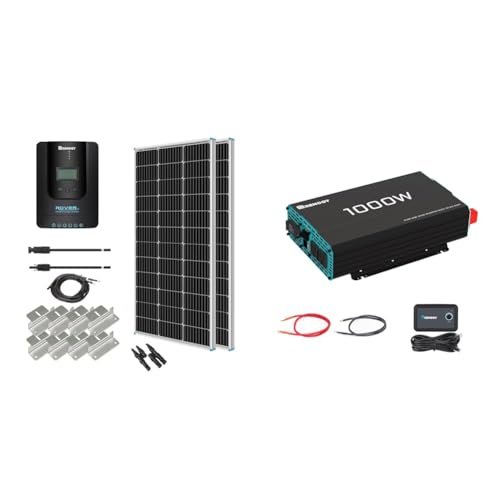
This Renogy bundle is the most complete package in the roundup: the company’s 200W monocrystalline starter kit (two 100W panels with 22 percent cell efficiency), the Rover 40A MPPT charge controller, and a 1000W pure sine wave inverter. Renogy rates the array for roughly 800Wh of daily output in four hours of usable sun, enough for a 12V fridge, lights, water pump, and device charging on most rigs.
The Rover is the reason to buy this version. MPPT tracking (up to 99 percent tracking efficiency and 98 percent peak conversion) extracts meaningfully more energy than PWM in cool weather, low light, or partial shade, and the controller auto-detects 12V or 24V systems, supports lithium, gel, and lead-acid batteries, and protects against overcharge, over-discharge, short circuit, and reverse polarity. The inverter delivers clean 110V AC with a 2000W surge rating, two AC outlets, and GFCI protection. The honest caveats: this is the most expensive pick here, the inverter is an entry-level unit that heavy AC loads will outgrow, and roof-mounting two rigid panels means drilling and sealant work.
Pros
- True MPPT control with the Rover 40A, the strongest controller in this guide
- Supports lithium, gel, flooded, and sealed lead-acid batteries
- Includes a 1000W pure sine wave inverter with GFCI protection
- The most expensive kit in this roundup
- Entry-level inverter that serious AC users will outgrow
- Roof mounting two rigid panels requires drilling and sealing
- Single 200W 9BB panel with 22.8 percent stated efficiency
- Negative-ground 30A controller compatible with LiFePO4 and LTO lithium
- Backlit display with real-time PV and battery readouts
- PWM controller limits efficient expansion beyond roughly 450W
- One large panel is a single point of failure in partial shade
- 18-month product warranty is shorter than some rivals
- Zero installation: SAE plug for Zamp Solar Ready ports plus alligator clamps
- Handcrafted in the USA with a 25-year output warranty
- Integrated 5-stage controller with lithium support
- Reposition into full sun while the RV sits in shade
- Highest price per watt in this roundup by a wide margin
- 15A controller limits future expansion
- Requires setup and storage at every camp, and is more exposed to theft
- Lowest-priced complete kit with a name-brand controller
- Oversized 30A controller leaves real expansion headroom
- Monocrystalline panel with bypass diodes for shade tolerance
- Full cable and mounting hardware package included
- PWM charging gives up some harvest versus MPPT
- Small LCD and basic interface
- USB ports can drain the battery if left connected overnight
- The most proven beginner kit in RV solar, with strong documentation
- Wanderer 30A controller supports lithium via user-defined mode
- Expandable up to 400W without replacing the controller
- 10AWG cabling throughout, a heavier gauge than most rivals
- 100W is too little for refrigerators or heavy 12V loads
- PWM controller is less efficient than MPPT in marginal sun
- Basic controller without a detailed LCD display
- Complete RV Solar System with Batteries: the full system these kits plug into.
- Best 12V Deep Cycle Batteries for Solar: the battery bank your kit charges.
- What Size Charge Controller for a 100W Panel: the sizing logic behind every controller in this guide.
Cons
Check Price on Amazon: Renogy 200W Kit with 40A Rover MPPT and 1000W Inverter
2. BougeRV 200W 9BB Monocrystalline Kit with 30A PWM Controller: Best Single-Panel Design
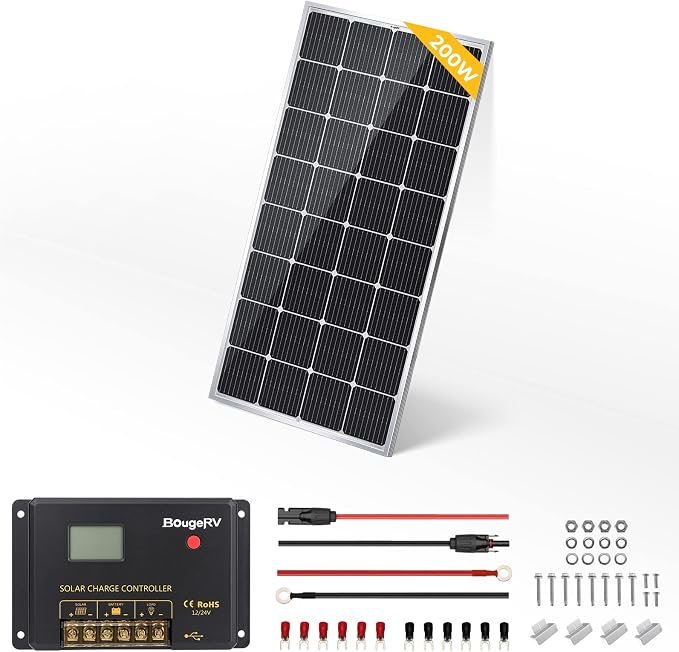
BougeRV takes a different approach: a single 200W panel built on a 9-busbar cell design with a manufacturer-stated 22.8 percent conversion efficiency, rather than two 100W panels. The single-panel layout means fewer roof penetrations, fewer connectors to fail, and a footprint smaller than many competing 200W panels, which matters on crowded RV roofs.
The included 30A PWM controller uses a negative-ground design that suits modern vehicle chassis wiring, with a backlit display and compatibility with sealed, flooded, and gel lead-acid batteries plus LiFePO4 and LTO lithium, and it can wake a dormant lithium battery after a protection shutdown. Twenty feet of 10AWG panel cable, 8 feet of battery cable, four Z brackets, and an IP67 junction box complete the kit. The tradeoff is controller headroom: 30A of PWM supports roughly 450W at 12V, so expansion is modest, and one large panel is a single point of failure in partial shade.
Pros
Cons
Check Price on Amazon: BougeRV 200W 9BB Mono Solar Panel Starter Kit
3. Zamp Solar Legacy Series 180W Portable Kit: Best Portable, No-Install Option
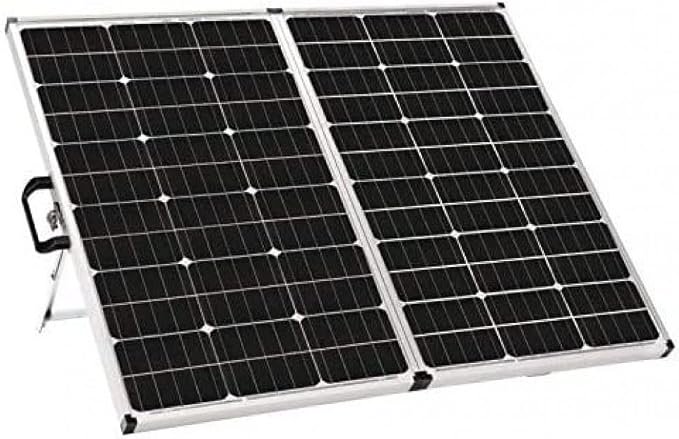
Not everyone wants to put holes in a roof. Zamp’s Legacy Series 180W portable is a foldable suitcase-style kit handcrafted in Bend, Oregon, with a 25-year output warranty and no installation: unzip the case, unfold the panel, extend the legs, and connect through the SAE plug that fits factory Zamp Solar Ready ports, or alligator clamps straight onto the battery.
The integrated 15A controller runs a 5-stage charging profile on an EZ-view hinged bracket, is weather resistant, and charges most 12V batteries including lithium, and a 15-foot cable lets you park the panel in full sun while the RV sits in shade. The costs are financial and physical: per watt this is the most expensive kit in the guide, the 15A controller caps expansion, and a panel on the ground needs deploying at every camp and is easier to walk off with than one bolted to a roof. Buy it for the flexibility, not the value.
Pros
Cons
Check Price on Amazon: Zamp Solar Legacy 180W Portable Solar Panel Kit
4. HQST 100W Monocrystalline Kit with 30A PWM LCD Controller: Best Budget Starter Kit
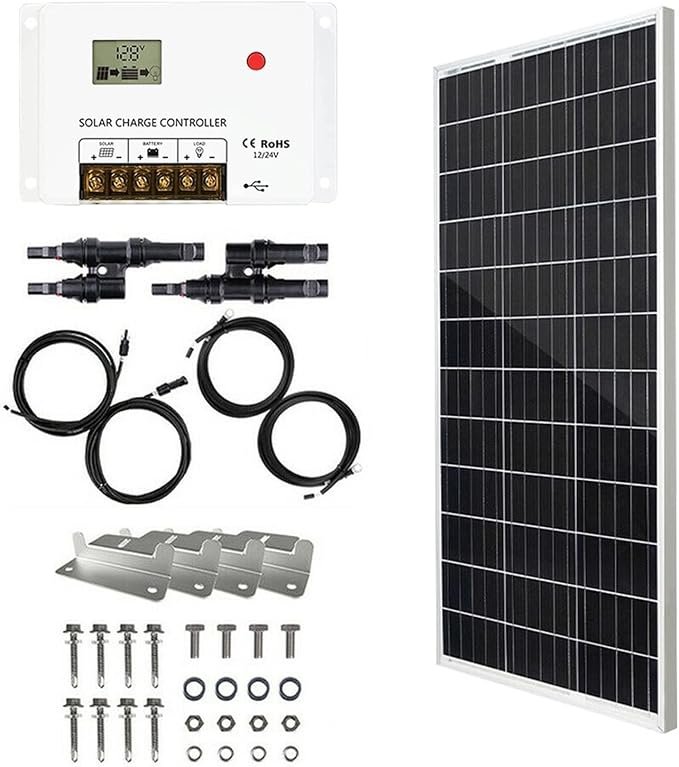
HQST has long been the value alternative to Renogy in budget solar, and this 100W kit shows why. You get a monocrystalline panel with up to 21 percent cell efficiency and bypass diodes for low-light performance, a 30A PWM controller with LCD and dual USB ports, 20 feet of 12AWG panel cabling, 8 feet of 10AWG battery cabling, and a set of Z brackets. The controller auto-detects 12V or 24V systems and provides overcharge, over-discharge, overload, and short-circuit protection.
The 30A rating is the sleeper feature: a 100W panel needs only about 6 amps of controller capacity, so you can add two or three more panels later without replacing anything. The panel is rated for 2400Pa wind and 5400Pa snow loads, and pre-drilled holes make the install a one-afternoon job. The downsides are the price class, not defects: PWM gives up some harvest versus MPPT in cold or cloudy conditions, the LCD and menu are basic, and the USB ports can drain the battery if devices stay connected overnight.
Pros
Cons
Check Price on Amazon: HQST 100W Monocrystalline Solar Panel Kit with 30A PWM LCD
5. Renogy 100W Starter Kit with 30A Wanderer Controller: Best Trusted Entry-Level Kit
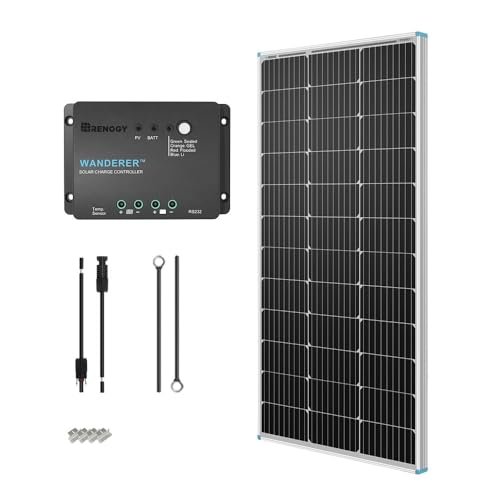
This is the kit that popularized RV solar for beginners, and it remains a sensible first purchase: a 100W monocrystalline panel, Renogy’s Wanderer 30A PWM controller, a 20-foot 10AWG MC4 adapter kit, an 8-foot tray cable, and Z brackets. Renogy rates it around 500Wh per day in good sun, enough to charge a 50Ah battery from 50 percent in roughly three hours, and the Wanderer supports expansion up to 400W of panels.
The Wanderer is a negative-ground PWM controller with four-stage charging; the current version supports sealed, gel, flooded, and lithium batteries, with the lithium profile set through a user-defined mode. Renogy’s documentation, warranty support, and replacement-part availability are the best in the budget segment, which matters when a part fails two seasons in. The limitations are inherent to 100W: this is maintenance and light-use charging that will not keep up with a 12V compressor fridge running all summer, and PWM gives up some efficiency compared with the Rover MPPT. Start here if your loads are light and your budget is tight, then expand.
Pros
Cons
Check Price on Amazon: Renogy 100W Solar Panel Starter Kit with Wanderer 30A
How to Choose an RV Solar Kit
Match the wattage to your loads. Lights, vent fans, water pump, and device charging add up to 30 to 50Ah per day, which 100W covers in decent sun. A 12V compressor refrigerator pushes daily use past 60Ah, which is 200W territory. Air conditioning is not realistic from any kit in this class; that is a far larger panel, battery, and inverter project.
Pick the controller deliberately. MPPT controllers extract 10 to 30 percent more energy than PWM in cool, cloudy, or shaded conditions, at a higher price. PWM is fine for budget builds in sunny climates. If your camping includes trees, fog, or shoulder seasons, MPPT earns its premium; our guide on what size charge controller you need for a 100W panel covers the sizing math in detail.
Confirm lithium support before buying. If you run or plan to run LiFePO4 batteries, make sure the controller lists lithium support, and select the lithium profile in settings after installation. All five controllers in this guide handle lithium in some form.
Roof mount or portable. Roof kits charge all day unattended and stay secure, but need drilling, sealant, and full sun on the rig. Portables cost more per watt and need handling at every camp, but you can chase the sun and use them away from the RV. Many RVers eventually run both.
Leave expansion room. Oversize the controller relative to the panels you buy first, as the HQST and Renogy starter kits do. Panels are easy to add; a too-small controller means buying the same part twice. If the battery bank is the weak link, our best 12V deep cycle batteries for solar guide covers the storage side.
Frequently Asked Questions
What size RV solar kit do I need?
For weekend trips with light 12V loads, 100W is a workable start. With a 12V refrigerator or regular boondocking, 200W is the realistic floor. Expect roughly 30 to 50 percent of a panel’s rated wattage as amp-hours per day into a 12V battery, so a 200W kit delivers around 60 to 100Ah daily in good conditions.
Can I run my RV air conditioner on a solar kit?
No kit in this class can. A 15,000 BTU rooftop AC draws over 1,300W continuously, which would demand well over 1,500W of panels plus a large battery bank and inverter. These kits are sized for 12V loads and small AC devices.
Is a portable solar kit better than a roof-mounted one for RVs?
Neither is universally better. Roof kits work unattended all day, stay secure, and cost less per watt; portables let you park in shade and put the panel in sun, and they move to a second vehicle. If you camp in open sun mostly, go roof mount. If you camp under trees, a portable like the Zamp 180W earns its price.
Can I expand my kit later with more panels?
Usually yes, if the controller has headroom. The HQST and Renogy starter kits use 30A controllers that accept up to roughly 400 to 450W at 12V, so you can add panels before outgrowing the controller. Match the wiring configuration to the controller’s input limits; our charge controller sizing guide explains series versus parallel tradeoffs.
Tags: rv-solar-power, rv-solar-panel-kit, rv-off-grid-solar, renogy, mppt, solar-kits