Best Portable Solar Panels for Power Stations (2026)
By Rowan Watts
Affiliate Disclosure: This post contains affiliate links, including Amazon Associates links. As an Amazon Associate we earn from qualifying purchases at no extra cost to you.
A portable power station is only half of an off-grid setup. Without a panel to refill it, a power station is just a big battery that slowly drains, and the fastest way to make it genuinely useful at a campsite, in an RV, or during an outage is to pair it with a foldable solar panel you can unfold in seconds. The best portable solar panel for your power station is the one that matches its input limits, survives being carried around, and actually delivers usable wattage in less than perfect sun.
This guide compares five foldable and briefcase-style panels we would recommend in 2026, from a 200W glass suitcase that refills large stations quickly to sub-7-pound panels built for backpacks and RV trips. Every pick links to a live Amazon listing, and we note the honest drawbacks of each one. If you have not chosen the battery side of the equation yet, our roundup of the best portable power stations for home backup covers that first decision.
Quick Picks: Best Portable Solar Panels of 2026
| Product | Best For | Wattage | Weight |
|---|---|---|---|
| Renogy 200W Portable Suitcase | Fast charging for large stations | 200W | 28.5 lbs |
| Jackery SolarSaga 100W Air | Jackery owners and ultralight travel | 100W | 7.1 lbs |
| EcoFlow 110W Portable Panel | EcoFlow owners who want weather sealing | 110W | 8.8 lbs |
| BigBlue SolarPowa 100 | Universal compatibility on a budget | 100W | 6.5 lbs |
| HQST 100W Solar Suitcase | Charging 12V batteries, not just stations | 100W | 27 lbs |
How We Chose These Panels
Three filters shaped this list. First, brand track record: all five come from companies with established support networks, since hinges, fabric, and junction boxes fail long before solar cells do. Second, compatibility: every panel here either includes the adapters needed to reach mainstream power stations from Jackery, EcoFlow, Bluetti, Anker, and Goal Zero, or terminates in industry-standard MC4 that adapter cables can convert. Third, honest output: all foldables fall short of rated wattage in real sun, but these use quality monocrystalline or N-type cells that hold their output better than no-name panels.
The Best Portable Solar Panels for Power Stations in 2026
Best Overall: Renogy 200W Portable Solar Suitcase
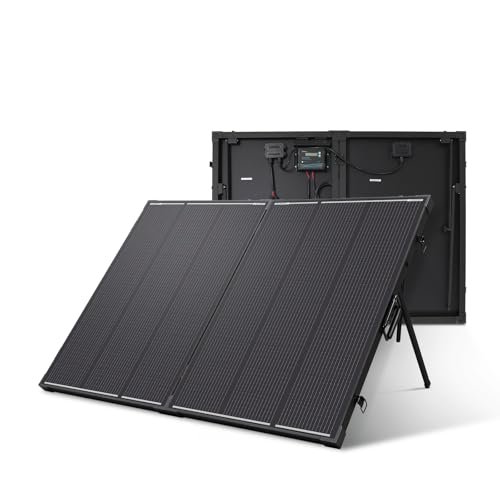
The Renogy 200W suitcase is the panel we reach for when charging speed matters more than packing light. It pairs two 100W glass-faced panels with 25 percent efficient N-type cells behind tempered glass, an adjustable kickstand on each half, and a pre-installed waterproof 20A PWM charge controller, so it can feed a power station through its cable or charge a 12V battery directly with the included alligator clips. Rated input on the station side is straightforward: the panel’s MC4-terminated output works with any adapter cable your station’s input port requires.
The glass construction is the quiet advantage. Fabric-laminated foldables lose output as they age and hot-spot more easily when partially shaded, while the Renogy’s tempered glass surface sheds rain and shrugs off abrasion in daily field use. At 28.5 pounds it is not light, but the built-in latches and handle make it behave like actual luggage.
Pros
- Highest output on this list
- Tempered glass durability
- Integrated 20A controller doubles as a battery charger
- Sturdy kickstands
- At 28.5 pounds it is the heaviest pick here and takes up real trunk space
- The PWM controller is tuned for 12V battery charging rather than squeezing maximum wattage into a power station, so expect somewhat lower efficiency than a pure MPPT setup
- Costs more per watt than the fabric panels below
- 7.1 pounds and genuinely compact when folded
- Bifacial rear-side gain in reflective conditions
- Clean one-cable setup with Jackery stations
- Aluminum stand included
- The per-watt price is high for 100W
- The DC8020 termination favors Jackery hardware, so other brands need adapter cables that are not included
- The listing rates it IP65 (Jackery’s own site claims IP68), which handles rain but not sustained soaking
- Bifacial gain only materializes when the back face has something reflective to work with
- IP68 waterproofing, the best weather sealing on this list
- Case-and-kickstand design needs no extra hardware
- MC4 termination keeps it adaptable
- Solid 23 percent cell efficiency
- One of the most expensive panels per watt in its class
- The XT60 cable bias means EcoFlow owners get the best experience while everyone else buys adapters
- The kickstand angles are coarse, and the fabric face can flap in gusty wind
- Widest adapter bundle included
- Direct USB-C PD and USB-A charging
- N-type cells at a budget price
- 6.5 pound carry weight
- BigBlue is newer to solar than the legacy brands, so its long-term track record is thinner
- The DC output voltage limits which stations accept it at full speed, and BigBlue itself recommends checking your station’s input range before buying
- The kickstands are less stable than a framed suitcase in wind
- Lowest cost per watt on this list
- Complete kit with controller and cables included
- Rugged aluminum frame
- Genuinely plug-and-play for 12V systems; if you are building out an RV electrical system around it, our complete RV solar system with batteries guide shows where a suitcase like this fits
- The 10A controller caps usable output well below what the panels can deliver in ideal sun
- Aimed at lead-acid chemistry rather than lithium profiles, so confirm your battery type before buying
- The latches and hinges are serviceable rather than premium
- Best Portable Power Stations for Home Backup
- Best Solar Generators for Camping
- Jackery vs EcoFlow vs Bluetti
- Complete RV Solar System with Batteries
- Best 12V Portable Refrigerators for Camping
Cons
Check Price on Amazon: Renogy 200W Portable Solar Suitcase
Best for: RVers, van lifers, and home-backup owners running 500Wh-and-up power stations who want the shortest realistic recharge time.
Best for Jackery Owners: Jackery SolarSaga 100W Air
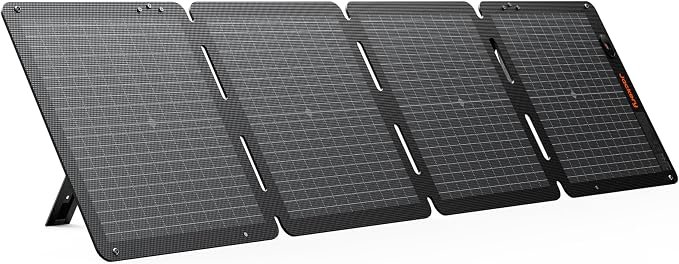
The SolarSaga 100W Air is Jackery’s current lightweight panel, and its headline number is weight: 7.1 pounds, roughly 27 percent lighter than a typical 100W folding panel. It folds into four sections that compress smaller than a sheet of A2 paper, and the included aluminum stand sets it up in about a minute. The cells are bifacial PERC rated at 23 percent efficiency, meaning the rear side harvests reflected light when snow, sand, or pale ground bounces sunlight back at the panel.
Integration is the reason Jackery owners should start here. The DC8020 connector and 3-meter cable plug straight into current Jackery Explorers, and the included DC8020-to-DC7909 adapter covers older Explorer models, which removes the one mistake most likely to brick a charging session. If you are still weighing brands, our Jackery vs EcoFlow vs Bluetti comparison breaks down where each ecosystem locks you in.
Pros
Cons
Check Price on Amazon: Jackery SolarSaga 100W Air
Best for: Jackery power station owners and anyone who counts every pound in a pack or overhead bin.
Best for EcoFlow Owners: EcoFlow 110W Portable Solar Panel
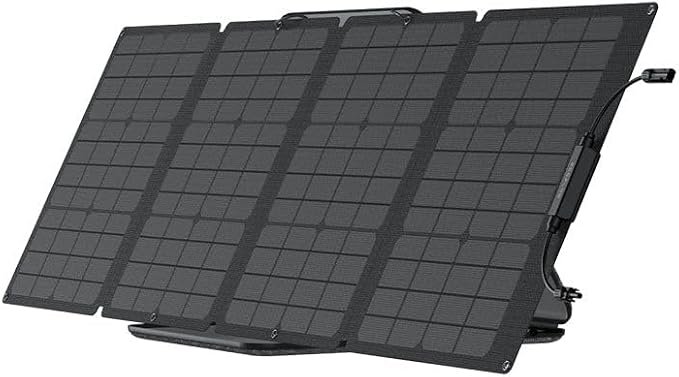
EcoFlow’s 110W panel is a four-section foldable that packs into a zippered carry case, and the case itself is the clever part: unfolded, it becomes an adjustable kickstand that angles the panel toward the sun without any separate hardware. Spec-wise it is a close cousin of the Jackery Air, with a 21.8V open-circuit voltage, 6.5A short-circuit current, and monocrystalline cells rated around 22 to 23 percent efficiency, but it weighs 8.8 pounds and carries an IP68 rating, the best weather sealing on this list. EcoFlow tested the laminate submerged, and the junction box and fabric are sealed accordingly.
The included cable runs MC4 to XT60, which connects directly to EcoFlow’s Delta and River stations, and the MC4 end means third-party stations remain reachable with a cheap adapter. Output sits a notch above the 100W panels here, enough to matter when you are refilling a station day after day on a long trip.
Pros
Cons
Check Price on Amazon: EcoFlow 110W Portable Solar Panel
Best for: EcoFlow power station owners who camp through real weather and want a panel they do not have to baby.
Best Universal Compatibility: BigBlue SolarPowa 100
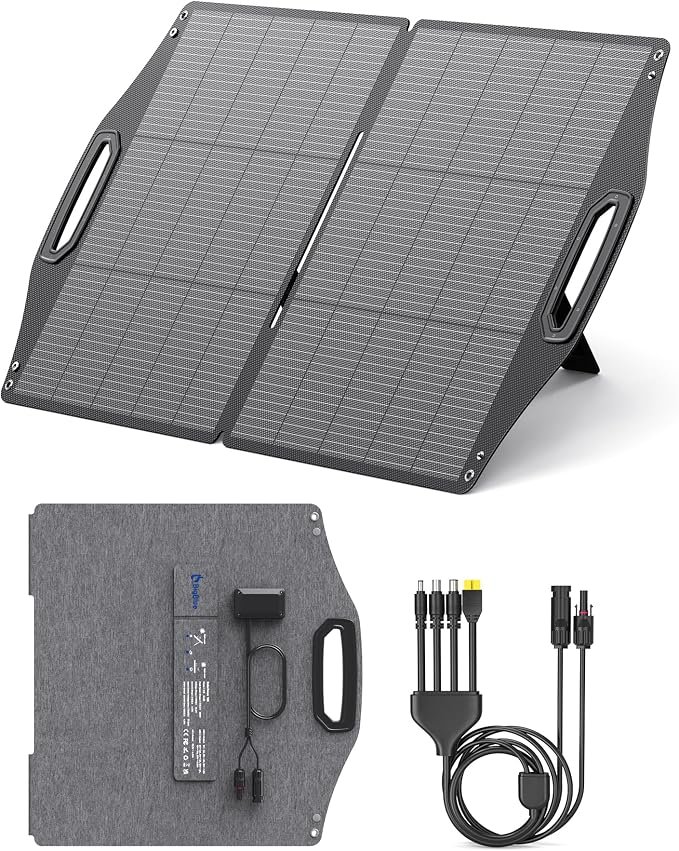
The BigBlue SolarPowa 100 is the value pick, and the reason it earns a place on this list is flexibility. Its DC output runs through an industry-standard MC4 connector at 17.4V/5.74A, and the box includes an MC4-to-adapter cable covering DC5521, DC8020, DC7909, and XT60-F plugs, which covers the vast majority of power stations sold today. Unusually for a panel at this price, it also carries a 45W USB-C PD port and an 18W USB-A port, so phones, tablets, and drones can charge directly without a power station at all.
The cells are N-type, rated up to 25 percent efficiency, behind an ETFE laminate that resists the yellowing and clouding that kill cheap PET panels within a couple of seasons. The IP68 rating covers the panel face, and at 6.5 pounds with two fold-out kickstands it is the lightest panel here that still aims at the sun.
Pros
Cons
Check Price on Amazon: BigBlue SolarPowa 100
Best for: budget-conscious buyers who want one panel that works with nearly any power station and still charges USB devices directly.
Best for 12V Batteries: HQST 100W Solar Suitcase
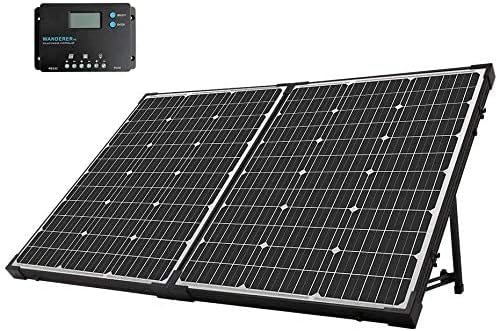
Not every portable panel purchase is about a power station. If your goal is keeping a 12V deep cycle battery charged in an RV, a trailer parked in storage, or a cabin shed, the HQST 100W suitcase does the job for less money than any fabric panel of the same wattage. It folds into a hard-sided aluminum briefcase containing two 50W monocrystalline panels, sturdy aluminum legs, and a 10A PWM charge controller with an LCD screen that shows charging status at the battery.
Setup is deliberately simple: unfold, lean it toward the sun, and clip the included alligator connectors onto the battery terminals. The controller handles sealed, gel, and flooded lead-acid batteries with four-stage charging, and the whole kit weighs about 27 pounds. It can still feed a power station through an adapter, though the PWM controller’s output profile is optimized for batteries rather than maximum-wattage station charging.
Pros
Cons
Check Price on Amazon: HQST 100W Solar Suitcase
Best for: RV and off-grid battery owners who want a complete, cheap charging kit rather than a panel that only feeds a power station.
How to Match a Portable Panel to Your Power Station
Check the voltage window first
Every power station publishes a solar input range, for example 12V to 60V. Your panel’s open-circuit voltage, abbreviated Voc, must fall inside that window, and if you plan to wire two panels in series, the voltages add up. Exceeding the maximum input voltage can permanently damage the station’s charge circuitry, and no warranty covers that. The panels above range from a 20.88V Voc on the BigBlue to 21.8V on the EcoFlow, all safe for single-panel use on mainstream stations.
Connectors are solvable, voltage is not
MC4 has become the industry default, and every panel above either terminates in MC4 or includes adapters for it. Jackery’s DC8020, EcoFlow’s XT60, Goal Zero’s 8mm, and Anderson connectors are all one adapter away from MC4. Buy the adapter before the trip, not at the campsite.
Expect less than rated wattage
No foldable panel delivers its rated wattage in ordinary conditions. Angle, ambient temperature, haze, and the station’s own conversion losses routinely shave 25 to 40 percent off the label, so plan around realistic input when sizing a system. As a rough rule, a 100W panel refills about 400 to 600Wh on a good sunny day, which covers a 12V portable refrigerator, lighting, and device charging with room to spare.
Weight is the spec you will feel
Glass suitcases charge fastest but cost you trunk space and a sore shoulder. Fabric foldables between 6 and 9 pounds get taken along far more often, and a panel that stays home charges nothing. If solar generators are new to you, our guide to the best solar generators for camping covers complete panel-and-station bundles.
FAQ
Can I use a Renogy or HQST panel with a Jackery or EcoFlow power station?
Yes, with the right adapter. Those panels output through standard MC4 or included clip cables, and MC4-to-DC8020 or MC4-to-XT60 adapters cost a few dollars. What matters is the voltage window and input current limit of your specific station, so check both before wiring anything in series.
Why is my 100W panel only producing 60 or 70 watts?
Rated wattage comes from laboratory conditions: 1000W per square meter of sunlight at 25 degrees Celsius cell temperature. Real sun is weaker, panels heat up in direct sun and lose output, and flat or badly angled placement compounds the loss. Sixty to 80 percent of rated output on a clear day is normal for a folding panel.
Is bifacial worth it on a portable panel?
It depends on the ground under the panel. Snow, sand, and light-colored surfaces reflect enough light to give the rear cells a real contribution, while grass and dirt reflect very little. If you camp on dark forest floors, treat the bifacial rating as a bonus rather than a buying reason.
Do these panels work on cloudy days?
Yes, at reduced output. Monocrystalline and N-type panels typically deliver 10 to 25 percent of rated wattage under heavy overcast, enough to trickle-charge a power station but not to run a load directly. For outage preparedness, size your battery to cover the load and treat solar input as the refilling rate.
How should I position a portable panel during the day?
Face it directly at the sun and re-aim it two or three times between mid-morning and late afternoon. A panel left flat on a picnic table can lose 30 percent or more of its daily harvest compared with one that is re-angled, which is why the kickstands on every panel above earn their keep.
Related Reading
Tags: foldable-solar-panel, ecoflow, jackery, camping-power, emergency-power, diy-solar