Best Solar Charge Controllers for 2026: MPPT and PWM Picks
Affiliate Disclosure: This post contains affiliate links, including Amazon Associates links. As an Amazon Associate, we earn from qualifying purchases at no extra cost to you.
The best solar charge controller is the one that matches your array, your battery chemistry, and your budget without overspending on features you will never use. A charge controller sits between your panels and your battery bank, and it does two jobs: it harvests as much power as your panels can deliver, and it protects your batteries from overcharging. Pick the wrong one and you either leave energy on the table or risk shortening your battery’s life.
This guide rounds up five controllers we would actually recommend in 2026, covering premium MPPT units, a budget-friendly MPPT, and two simple PWM models. Whether you are wiring a cabin, an RV, or a small backup setup, there is a pick here that fits. If you are pairing a controller with a single panel, our guide to what size charge controller for a 100W panel walks through the math for that specific case.
Quick Picks: Best Solar Charge Controllers of 2026
| Product | Best For | Type | Max Current | Check Price |
|---|---|---|---|---|
| Victron SmartSolar MPPT 100/30 | Premium efficiency and app control | MPPT | 30A | Check Price on Amazon |
| Renogy Rover 40A MPPT | Larger 12V and 24V off-grid banks | MPPT | 40A | Check Price on Amazon |
| EPEVER Tracer3210AN 30A MPPT | Budget MPPT with real tracking power | MPPT | 30A | Check Price on Amazon |
| Renogy Wanderer Li 30A PWM | Simple 12V systems on a tight budget | PWM | 30A | Check Price on Amazon |
| HQST 30A PWM | No-frills charging with a USB port | PWM | 30A | Check Price on Amazon |
How We Chose These Controllers
Every pick here meets a few baseline standards. It comes from a brand with an established track record in off-grid power. It supports the battery chemistry most homeowners actually run, including lithium and standard lead-acid types. And it carries recognizable safety protections: reverse polarity, overload, short circuit, and temperature compensation where applicable.
We also balanced type and price. MPPT controllers cost more but squeeze 20 to 30 percent more energy out of the same panels, which matters in winter, in shade, or on oversized arrays. PWM controllers trade that efficiency for a much lower price, and for small matched systems they remain a perfectly sensible choice.
The Best Solar Charge Controllers for 2026
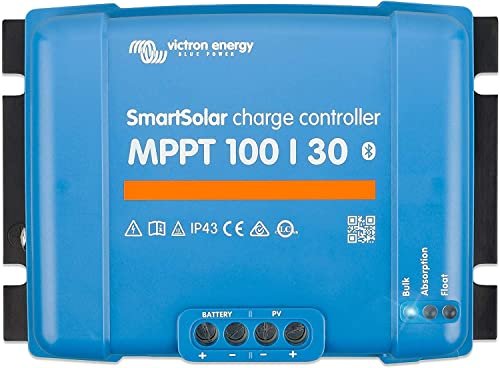
Best Overall: Victron SmartSolar MPPT 100/30
The Victron SmartSolar MPPT 100/30 is the controller we point to when someone asks for the best solar charge controller and does not want to compromise. It handles 30A of charge current on 12V or 24V battery banks, accepts panel open-circuit voltage up to 100V, and works with lithium, AGM, gel, flooded, and sealed batteries, each with its own charging profile.
Victron’s ultra-fast tracking algorithm is the headline feature. It re-reads the maximum power point many times per second, so passing clouds and partial shading cost you less energy than they would on slower trackers. Built-in Bluetooth pairs with the free VictronConnect app, where you can monitor harvest in real time, change charge parameters, and update firmware. The load output offers programmable battery protection, and the unit even attempts to recover deeply discharged batteries.
Pros: class-leading tracking efficiency, excellent app, built-in Bluetooth, wide battery support, strong reputation for reliability.
Cons: no physical display, so setup depends on a phone or an optional accessory. It also costs noticeably more than mid-range alternatives, and the 30A ceiling means very large 12V arrays will need a bigger model.
Best for: homeowners who want set-and-forget performance and detailed monitoring, especially on mixed or partially shaded arrays.
Check Price on Amazon: Victron SmartSolar MPPT 100/30
Best for Large Off-Grid Banks: Renogy Rover 40A MPPT
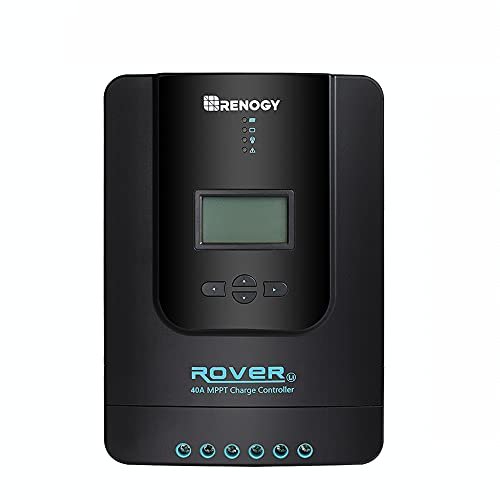
The Renogy Rover 40A is the workhorse of this list. It delivers 40A of charge current on automatically detected 12V or 24V systems, accepts up to 100V of solar input, and supports roughly 520W of panel power at 12V or double that at 24V. Battery support covers sealed, gel, flooded, and lithium, with charging parameters adjustable from the built-in LCD if your battery manufacturer specifies something custom.
Where the Rover pulls ahead for bigger systems is capacity and control. The LCD screen shows live charging data without any app, an RS485 port accepts Renogy’s Bluetooth module for phone monitoring, and the die-cast aluminum housing sheds heat during long summer charge cycles. It can also wake and recharge over-discharged lithium batteries, which cheaper controllers often refuse to do.
Pros: high 40A capacity, on-device display, adjustable parameters, lithium reactivation, solid protection suite.
Cons: it is physically large and heavier than the other picks, and the Bluetooth dongle is sold separately. For a 200W RV setup it is simply more controller than you need.
Best for: cabins and larger 12V or 24V banks in the 400W to 800W range that need one dependable controller. If you are building out a full system, our roundup of the best solar panels for an off-grid cabin pairs well with it.
Check Price on Amazon: Renogy Rover 40A MPPT
Best Budget MPPT: EPEVER Tracer3210AN 30A
EPEVER’s Tracer AN series has long been the entry point for real MPPT tracking at a PWM price, and the 30A Tracer3210AN (G3) continues that role. It auto-detects 12V or 24V systems, takes up to 100V of panel input, handles a maximum of about 390W at 12V or 780W at 24V, and supports lead-acid types including gel and AGM along with lithium batteries.
Tracking efficiency is the strong suit: EPEVER rates the MPPT algorithm above 99 percent, with overall conversion efficiency up to 98 percent. The unit ships in this listing with the MT52 remote meter and a temperature sensor, which together give you a proper display and voltage compensation that the bare controller lacks. Common-negative grounding makes it compatible with many vehicle and marine electrical setups.
It is also one of the few controllers at this price that ships with both a remote meter and a temperature sensor included.
Pros: genuine MPPT harvesting at a budget price, high tracking efficiency, included remote meter and temperature sensor in this bundle.
Cons: the menu system is not intuitive, and the translated manual takes patience. Bluetooth requires an optional separate module, and fit and finish do not match Victron.
Best for: DIYers who want MPPT efficiency on a budget and do not mind reading the manual twice.
Check Price on Amazon: EPEVER Tracer3210AN 30A MPPT
Best Budget PWM: Renogy Wanderer Li 30A
The Renogy Wanderer Li 30A is one of the most popular small-system controllers ever sold, and the reason is simple: it does one job cheaply and reliably. It is a 30A PWM controller for 12V banks only, with a maximum panel input around 25V, which means it is designed for one or two standard 12V nominal panels wired in parallel. Battery support covers lithium, sealed, gel, and flooded types.
The Wanderer uses a four-stage charging routine, provides temperature compensation through its built-in sensing, and is negative-ground compatible, which keeps it friendly to RVs and vehicles. Pairing it with a matching Renogy panel and battery is about as close to plug-and-play as 12V solar gets, and our guide to the best 12V deep cycle battery for solar covers the battery side of that equation.
Pros: very affordable, dead-simple operation, lithium support, compact and light.
Cons: PWM topology wastes a meaningful share of panel output compared with MPPT, it cannot accept higher-voltage or series-wired panels, and there is no display or Bluetooth at all.
Best for: small RV, shed, and backup kits with one or two 100W panels where the lowest workable cost matters most.
Check Price on Amazon: Renogy Wanderer Li 30A PWM
Also Great on a Budget: HQST 30A PWM
The HQST 30A PWM is a close alternative to the Wanderer with a couple of extras some buyers will appreciate. It automatically detects 12V or 24V battery banks, works with standard sealed, gel, AGM, and flooded lead-acid batteries, and includes a 5V USB output for charging phones and small devices directly from the controller.
Build quality is better than the price suggests: the housing feels solid, and the protection set covers reverse polarity, overload, short circuit, and over-temperature conditions. The integrated LCD and two-button interface give you a plain read on charging and fault status without needing any app.
Pros: low price, 12V/24V auto-detection, built-in USB charging, straightforward on-device display.
Cons: PWM efficiency losses apply here just as with the Wanderer, there is no Bluetooth or remote display option, and battery chemistry selection is aimed at lead-acid rather than lithium.
Best for: small lead-acid systems where a USB port for device charging earns its keep.
Check Price on Amazon: HQST 30A PWM
MPPT vs PWM: Which Type Do You Need?
The difference comes down to how each type matches panel voltage to battery voltage. A PWM controller effectively connects the panel straight to the battery, pulling panel voltage down to battery level and wasting the difference. That is fine when your panel is deliberately matched to the battery, as in most small 12V kits.
An MPPT controller converts the excess voltage into extra charging current instead. On a cold day, in the morning, or with panels wired in series, that conversion routinely captures 20 to 30 percent more energy. As a rule of thumb: if your array is over about 200W, or your panels are wired in series, or you live somewhere with real winters, MPPT pays for itself. If you have a single 12V panel and a matched battery, PWM is still a rational buy.
How to Size a Charge Controller
Sizing has two parts: current rating and voltage rating. Voltage first: add up the open-circuit voltage of your panels as wired, then add a cold-weather margin, and keep the total below the controller’s maximum input voltage, which is 100V on the MPPT picks above.
Current is simpler. Divide your total panel wattage by your battery bank voltage, then add 25 percent headroom so the controller is not running at its ceiling on bright cold days.
Worked example: you have 400W of panels feeding a 24V battery bank, a common size for small cabins.
- Watts divided by volts: 400 / 24 = 16.7A of maximum charging current.
- Add 25 percent headroom: 16.7 x 1.25 = 20.8A.
- Choose the next size up: a 30A controller, such as the EPEVER Tracer3210AN, gives you comfortable margin and room to add a panel later.
For a deeper dive on small systems, see our guide to charge controller sizing for a 100W panel.
A Few Installation Notes Before You Buy
Whichever model you choose, a handful of habits will protect both the controller and your batteries. Use wire sized for the full rated current with a small safety margin, and place a fuse or breaker on the battery side within a few inches of the terminal. Tighten terminals to the specified torque and recheck them after the first week of thermal cycling, since loose connections are the most common cause of heat buildup at the controller.
Ventilation matters more than most first-time builders expect. MPPT controllers convert excess panel voltage into heat, and every model above derates its output as internal temperature climbs. Mounting a controller in a closed cabinet or in direct sun quietly shrinks the harvest you paid for, so leave clearance around the heat sink and follow the spacing in the manual. Finally, label both ends of every wire while it is cheap to do so; future-you, tracing circuits by flashlight, will be grateful.
FAQ
Is an MPPT charge controller really worth the extra money?
Usually, yes, if your array is 200W or larger or your panels are wired in series. The 20 to 30 percent harvest gain over PWM compounds across seasons, and on a mid-sized system the upgrade typically pays for itself within a couple of years of extra production. On a single-panel 12V kit, a PWM controller remains the smarter purchase.
Can I use a 30A controller with a 100W panel?
You can, and it will work safely, but it is oversized. A 100W panel on a 12V battery produces roughly 8.3A, so even with 25 percent headroom a 10A or 15A controller is the right fit. Oversizing does no harm beyond the extra cost, and it leaves room to expand.
Do all these controllers work with lithium batteries?
Four of the five do: the Victron SmartSolar 100/30, Renogy Rover 40A, EPEVER Tracer3210AN, and Renogy Wanderer Li all support lithium charging profiles. The HQST 30A PWM is oriented toward lead-acid chemistries, so confirm compatibility with your specific battery before buying it for a lithium bank.
What happens if my panels exceed the controller’s maximum input voltage?
You risk permanent damage to the controller, and it is not covered as a warranty claim. Series wiring adds panel voltages together, so always total the open-circuit voltage ratings, add a cold-weather margin of roughly 10 percent, and stay below the controller’s limit with room to spare.
Where should I mount my charge controller?
Close to the battery bank, in a dry, ventilated space, and never directly above the batteries where corrosive gases can reach the electronics. Keep the panel-to-controller wire run as short as practical to reduce voltage loss, and follow the wiring order in the manual: battery first, then panels.