Best Solar Attic Fans (2026): Cool Your Attic for Free
Affiliate Disclosure: This post contains affiliate links. If you buy through our links, we may earn a commission at no extra cost to you. As an Amazon Associate, we earn from qualifying purchases.
By Rowan Watts
The best solar attic fan does one simple job: it pulls superheated air out of your attic using a panel powered entirely by the sun, and it does so without adding a single dollar to your electric bill. In summer, a poorly ventilated attic can sit 40 to 50 degrees hotter than the outside air, and that heat slowly radiates down into your bedrooms and makes your air conditioner work harder. A well-chosen solar attic fan attacks the problem at the source.
This guide compares five of the strongest options for 2026 across both roof-mount and gable-mount styles, with verified wattage, airflow, and coverage figures for each. We also cover the honest math on savings, sizing your fan correctly, and whether a solar fan actually makes sense for your roof. If your broader goal is cutting household energy waste, pairing a fan with a device from our best home energy monitor guide is a smart first step, because it shows you exactly where your electricity goes.
Quick Picks: Best Solar Attic Fans at a Glance
| Product | Best For | Wattage | Airflow (CFM) |
|---|---|---|---|
| iLIVING Hybrid Smart 40W Roof Fan | Best overall | 40W | 1,150 |
| QuietCool AFR SLR-40 Roof Fan | Premium hybrid pick | 40W | 1,092 |
| Remington Solar 30W Roof Fan | Large attics on a budget | 30W | Up to 1,550 |
| Master Flow GreenMachine | Lowest profile on the roof | Integrated panel | Up to 750 |
| Amtrak Solar 12-Inch Gable Fan | Budget DIY gable install | Pair with 40W to 100W panel | Up to 3,000 (with 100W panel) |
The 5 Best Solar Attic Fans of 2026
1. iLIVING Hybrid Smart 40W Solar Roof Attic Fan: Best Overall
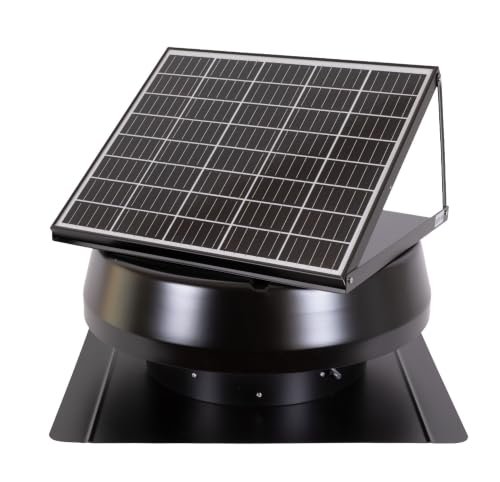
The iLIVING ILG8SF301A hits the sweet spot of airflow, controls, and warranty, which is why it tops our list of the best solar attic fan options this year. It moves 1,150 CFM through a 14-inch nylon-fiber-aluminum blade and is rated to cool attic spaces up to 2,900 square feet. The 40-watt polycrystalline panel adjusts through four angles (0, 15, 30, and 45 degrees) so you can tilt it toward the sun regardless of your roof pitch.
What separates it from cheaper roof fans is the built-in smart thermostat, adjustable from 50 to 122 degrees Fahrenheit with an enable and disable switch, plus an included AC/DC adapter that lets the fan keep running after dark. The brushless motor is IP68 waterproof and backed by a 15-year limited manufacturer warranty. It is one of the best-reviewed ventilation fans on Amazon, with a 4.4 star average across more than 1,600 ratings at the time of writing.
Key specs: 40W panel, 1,150 CFM, up to 2,900 sq ft, thermostat included, AC/DC adapter included, 15-year warranty.
2. QuietCool AFR SLR-40 Solar Roof Mount Attic Fan: Premium Hybrid Pick
QuietCool built its reputation on whole-house fans, and the AFR SLR-40 brings the same build quality to solar attic ventilation. This roof-mount unit pairs a 40-watt panel with an ultra-efficient DC motor in a heavy-duty steel housing, delivering 1,092 CFM per dealer specification sheets (791 CFM on solar alone). A preset thermostat cycles the fan automatically on hot days, so there is nothing to configure or remember.
The headline feature is the included AC/DC inverter. Like the iLIVING, it can draw house power when the sun is down, but QuietCool integrates it out of the box with no add-on purchases. QuietCool recommends sizing attic fans at 0.5 CFM per square foot of attic space for every 2 feet of peak attic height, which puts this fan in the range of most attics up to roughly 1,900 square feet at typical ceiling heights. If you want a set-and-forget unit from a brand with deep ventilation expertise, this is the one.
Key specs: 40W panel, 1,092 CFM, preset thermostat, AC/DC inverter included, steel housing.
3. Remington Solar 30W Roof Mount Attic Fan: Best Value for Large Attics
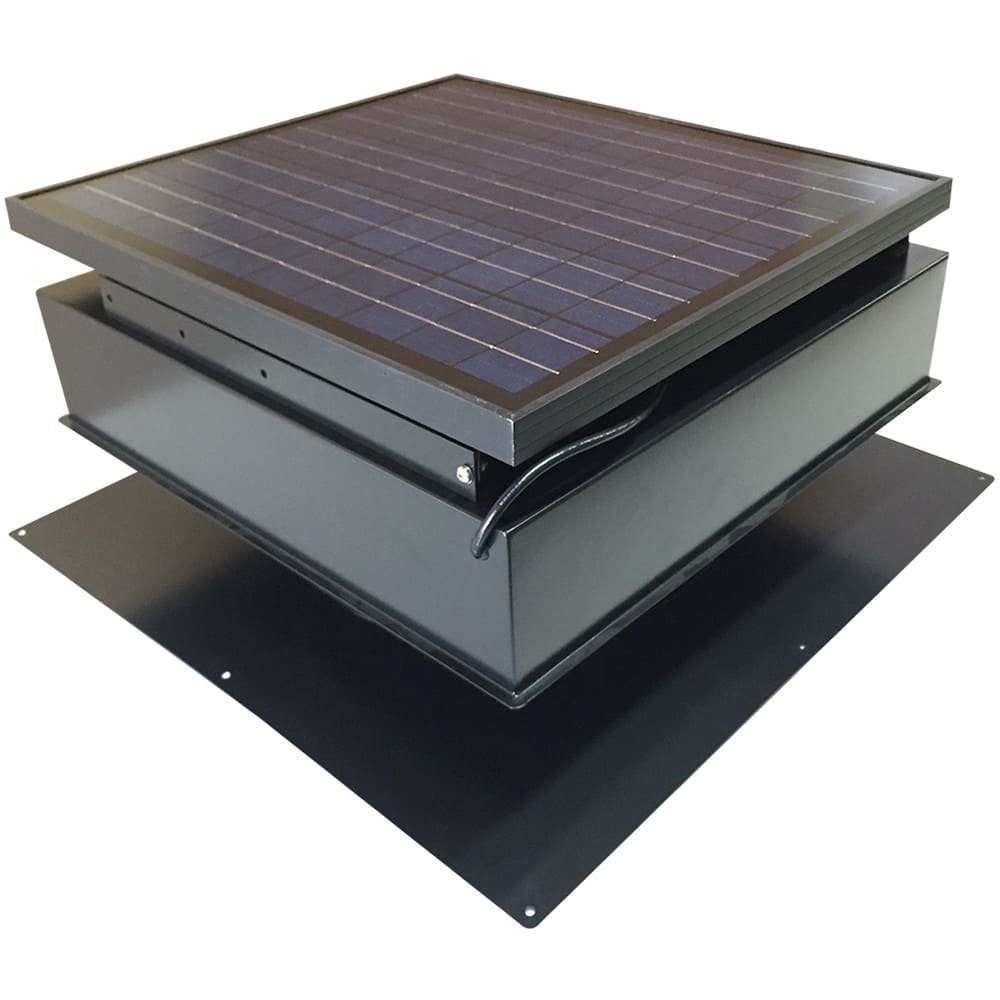
Remington’s SF30-BLK packs a lot of capability into a mid-priced unit. The manufacturer’s specification sheet rates it at up to 1,550 CFM and coverage of up to 2,000 square feet of attic space, figures that undercut most 40-watt competitors on price. The powder-coated steel housing is hail and weather resistant, and the brushless motor needs no maintenance.
Like the pricier fans here, it includes both a thermostat and a humidistat, so it responds to moisture as well as heat. That matters in climates with humid summers, where attic moisture control is half the battle. An optional hybrid adapter (sold separately) allows night running. Remington backs the fan with a limited lifetime warranty on parts and manufacturer defects. For homeowners who want maximum CFM per dollar on a bigger attic, this is our value pick. Remington also makes a 20-watt gable-mount version (about 1,280 CFM) if you would rather not cut into your roof.
Key specs: 30W panel, up to 1,550 CFM, up to 2,000 sq ft, thermostat and humidistat included, limited lifetime warranty.
4. Master Flow GreenMachine PRSOLAR2: Lowest Profile
The Master Flow GreenMachine (model PRSOLAR2), made by GAF, is the fan to buy when curb appeal matters. Its low-profile housing with an integrated black-frame solar panel sits nearly flush with the roofline, which is why roofing contractors often specify it on visible roof planes. It is also eligible as a component in GAF residential enhanced roof warranties, a detail that matters if your roof carries one.
Performance is more modest than the units above: up to 750 CFM from its integrated solar panel, designed to help cool up to 1,070 square feet of attic floor space when installed with proper intake ventilation. The solar-powered model includes a combination humidistat and thermostat, passes the 110 mph wind-driven rain test, and carries a 6-year limited warranty. For smaller attics, or as a discreet replacement for an aging electric power vent, it is an easy recommendation.
Key specs: integrated solar panel, up to 750 CFM, up to 1,070 sq ft, humidistat and thermostat included, 6-year warranty.
5. Amtrak Solar 12-Inch Gable Fan: Best Budget DIY Pick
The Amtrak Solar SPF-12 takes a different approach: it is a 12-volt DC fan head only, and you supply the solar panel. Amtrak rates it for use with panels from 40 to 100 watts (sold separately), and claims airflow up to 3,000 CFM when paired with a 100-watt panel, enough to cover attics up to 2,700 square feet by the company’s estimate. The 12 by 12 inch housing mounts inside an existing gable vent with four mounting tabs and pre-wired plug-and-play connectors, so there is no roof work and no wiring through your attic.
The trade-offs are real: there is no thermostat or humidistat, the fan runs whenever the panel sees sun, and you need to budget for a panel if you do not own one. Even so, at a street price around $55 it is by far the cheapest credible entry into solar attic ventilation, and it is equally at home in garages, sheds, greenhouses, and chicken coops. If you are comfortable with a screwdriver and a mid-size panel, nothing else here touches its value.
Key specs: 12V DC fan head (panel not included), works with 40W to 100W panels, up to 3,000 CFM claimed with 100W panel, no thermostat, gable or wall mount.
Roof-Mount vs Gable-Mount Solar Attic Fans
Roof-mount fans replace or sit near a roof vent on the back side of your roof, with the panel integrated into or beside the housing. They exhaust hot air at the highest point of the attic, which is ideal, and they work in homes with no gable vents. The downsides: installation means cutting or replacing a roof opening, a poor install can leak, and the unit is visible from the street on front-facing roof planes.
Gable-mount fans mount inside or over an existing gable wall vent, behind the louvers. Installation is far easier and safer (no roof penetration), the unit is invisible from outside, and maintenance means a trip into the attic rather than onto the roof. The catch: they require a usable gable vent, and because they pull air across the attic rather than up and out of the peak, airflow patterns can be slightly less effective in some roof designs.
A third option worth knowing: hybrid or dual-power fans (the iLIVING and QuietCool above) that switch to house power after sunset. They cost more but run around the clock in peak season.
Our advice: if you have a sound gable vent and basic DIY skills, start with a gable fan. If you want maximum exhaust performance or lack a gable vent, go roof-mount and consider hiring a roofer for the cut-in.
Do Solar Attic Fans Actually Save Money?
Here is the honest answer: it depends, and claims of dramatic savings deserve skepticism.
What a solar attic fan genuinely does is lower attic air temperature. That is well established. What that translates to in cooling savings depends heavily on three factors:
- Climate. In hot, sunny regions (the Southwest, Texas, Florida), attics spend months above 130 degrees, and venting that heat can meaningfully reduce the heat soaking into your living space. In mild climates, the fan may barely run.
- Insulation and air sealing. If your attic floor is well insulated (R-49 or better in cold climates, R-38 or more in hot ones) and your ceiling is air sealed, the attic was already largely isolated from your home, so a fan delivers smaller comfort gains. If insulation is thin, adding insulation will usually save you more money than any fan will.
- Adequate intake ventilation. A fan can only exhaust what it can replace. Without sufficient soffit or eave intake vents, a powerful fan can pull conditioned air from your living space through ceiling leaks, which makes your air conditioner work harder. This is the most common installation mistake.
- Small attic (up to 1,000 sq ft): a 750 CFM fan like the Master Flow GreenMachine is adequate.
- Medium attic (1,000 to 2,000 sq ft): look at 1,000 to 1,200 CFM, such as the QuietCool AFR SLR-40 or iLIVING 40W.
- Large attic (2,000 to 2,500+ sq ft): the Remington 30W is rated up to 2,000 sq ft, so plan on running two fans at this size.
Treat a solar attic fan as one layer in a whole-attic strategy, not a substitute for air sealing and insulation, which remain the highest-return efficiency upgrades in most homes. Used that way, in a hot climate, on a house with reasonable insulation, a quality fan is a low-risk purchase: it costs nothing to operate, it can extend shingle life by reducing heat stress, it helps vent moisture in winter, and it may trim cooling costs modestly. If your goal is a leaner energy bill overall, our roundup of 10 easy ways to reduce your energy bill at home covers the upgrades with the fastest payback.
How to Size a Solar Attic Fan
A common rule of thumb, used by QuietCool and other manufacturers, is 0.5 CFM per square foot of attic floor space for every 2 feet of peak attic height. In practice:
Also confirm your intake ventilation (soffit, eave, or edge vents) covers at least the exhaust area you are adding, and check the panel wattage: more watts generally means the fan keeps pushing air in morning and late afternoon light, not just at solar noon.
FAQ
Do solar attic fans work on cloudy days?
They slow down but usually keep turning. Panels produce reduced output in diffuse light, so expect lower CFM in morning, evening, and overcast conditions. Hybrid models like the iLIVING and QuietCool switch to house power when solar output drops, which is their main selling point.
Where is the best place to install a solar attic fan?
Roof-mount units belong on the back side of the roof, out of street view, close to the ridge, several feet away from intake vents so the fan does not short-circuit airflow by pulling fresh air straight across the attic. Gable-mount units go behind an existing gable vent on any orientation that gets decent sun for the panel.
How long do solar attic fans last?
Quality units are built for 10 to 15 years or more. Brushless motors (used by all five picks) avoid brush wear, and warranties range from 6 years on the Master Flow to 15 years on the iLIVING and a limited lifetime warranty on the Remington. Panels typically degrade slowly and often outlast the motor.
Will a solar attic fan cool my upstairs bedrooms?
Indirectly, and modestly. By exhausting attic heat, the fan reduces the temperature difference across your ceiling, so upstairs rooms warm more slowly during the afternoon. It is not a substitute for insulation, air sealing, or air conditioning, and results vary a lot by house and climate.
Do I need a thermostat on a solar attic fan?
It is strongly preferred. Without one (as with the basic Amtrak fan head), the fan runs whenever the sun shines, including on cold winter days when you may not want to vent warm attic air. Thermostat-equipped models cycle on only above a set temperature, and humidistat-equipped models also respond to moisture.