Comparing Lithium Ion vs Lead Acid Batteries for Home Use
By Rowan Watts | Updated September 2026
This post contains affiliate links. As an Amazon Associate, ENERGY FOR THE TAKING earns from qualifying purchases at no extra cost to you.
When I first wrote this comparison in early 2025, lithium iron phosphate (LiFePO4) was gaining ground. A year and a half later, the shift is finished for most home applications. LiFePO4, a lithium ion chemistry built for deep cycling, now dominates new home energy installs, solar battery banks, and even budget builds. Prices for lithium batteries have fallen far enough that the old advice of “start with lead acid and upgrade later” rarely pencils out anymore.
But lead acid has not disappeared, and it should not. For some specific situations, a basic flooded or AGM lead acid battery is still the smarter buy. This guide walks through the full comparison as it stands in 2026: real cost per cycle, weight, cold weather behavior, charging differences, and the honest cases where lead acid still wins.
The Short Answer
For almost every home energy storage job in 2026, LiFePO4 is the better battery. It lasts 6 to 12 times longer in cycle life, weighs a fraction as much, needs zero maintenance, and delivers more of the energy you store. Lead acid still makes sense for tight budget builds, systems that sit unused for months, and warm indoor spaces where its weaknesses do not bite.
Note that the federal residential clean energy credit expired on December 31, 2025, so battery purchases no longer qualify for the 30 percent tax credit. That shifts the math toward lower upfront cost, which makes the cost per cycle comparison below even more important.
Side by Side Comparison Table
| Factor | LiFePO4 (Lithium Iron Phosphate) | Lead Acid (Flooded or AGM) |
|---|---|---|
| Cycle life (to 80 percent capacity) | 3,000 to 6,000 cycles | 300 to 500 cycles |
| Usable capacity per cycle | 80 to 100 percent depth of discharge | 50 percent recommended (80 percent kills it fast) |
| Round trip efficiency | 95 to 98 percent | 70 to 85 percent |
| Weight (per 100Ah at 12V) | About 25 to 30 lbs | About 60 to 70 lbs |
| Maintenance | None | Watering (flooded), terminal checks, full charge storage |
| Cold weather charging | BMS blocks charging below freezing on most models (heated versions fix this) | Charges at low temps but loses capacity and lifespan in heat and cold |
| Ventilation needed | No | Yes for flooded (hydrogen gas); AGM is sealed but still benefits from airflow |
| Typical upfront cost (per usable kWh) | Moderate and falling | Low |
| Effective cost per usable kWh cycle | Very low | High |
The Real Cost: Cost Per Cycle Math
This is the number that decides the argument, so let us actually do the math instead of waving at “long term value.”
Take a common home solar battery: a 12V 100Ah unit, which stores about 1.2 kWh.
Lead acid, 300 to 500 cycles at 50 percent depth of discharge. A decent 12V 100Ah AGM battery costs roughly $200 to $280. You can only use half of it, so your usable storage is 0.6 kWh per cycle. At 400 usable cycles:
- $240 purchase price divided by 400 cycles = $0.60 per cycle
- That is $1.00 per usable kWh delivered, and you will likely buy your second (and third) battery within two to three years of daily cycling.
- $300 purchase price divided by 3,000 cycles = $0.10 per cycle
- That is about $0.08 per usable kWh delivered, one twelfth the cost of lead acid.
- Daily cycling: solar self consumption, time of use shifting, off grid living. The cycle life math is not close.
- Anywhere weight or space is constrained.
- Systems you do not want to think about. No watering, no equalizing, no terminal corrosion.
- Fast recharge needs: limited sun hours, generator charging, or intermittent grid power.
- Partial state of charge use. Lead acid sulfates if it sits partially charged; lithium does not care.
- Strict budget builds. If the absolute ceiling on spend is $150 for a small backup bank that will be used a handful of times a year, lead acid delivers. The cost per cycle math above assumes you actually cycle the battery; if you cycle it twice a year, cycle life barely matters.
- Infrequent, emergency only use. A battery for occasional outages that gets maintained and kept topped up may never approach its cycle limit. Here the lower upfront cost wins because the cycle count never comes due.
- High surge current on a budget. Lead acid handles very short, heavy loads (well pumps, inverters starting motors) and tolerates overcurrent abuse better than a BMS protected lithium pack, which will simply shut off on overload.
- Simple charging setups. Old school charger, alternator, or generator setups without lithium profiles can charge lead acid acceptably, though modern chargers handle both.
- Available locally, today. Your town’s farm supply store has a flooded deep cycle battery on the shelf. If you need power tonight, that matters.
LiFePO4, 3,000 to 6,000 cycles at 80 to 100 percent depth of discharge. A quality 12V 100Ah LiFePO4 battery now runs roughly $250 to $400. You can use essentially all 1.2 kWh. At a conservative 3,000 cycles:
Even comparing the same nominal capacity, the lithium battery delivers 3,000 to 6,000 cycles against 300 to 500 for lead acid. That is not a small edge; it is a 6x to 12x difference in lifespan. Over ten years of daily cycling, you would buy one to two lithium batteries or eight to twelve lead acid ones.
Add efficiency on top: lithium’s 95 to 98 percent round trip efficiency versus lead acid’s 70 to 85 percent means a lithium system wastes far less of the solar power you just generated. With lead acid, up to a quarter of your harvested energy disappears as heat and gassing losses.
Weight, Space, and Installation
A 12V 100Ah lead acid battery weighs 60 to 70 pounds. The equivalent LiFePO4 battery weighs 25 to 30 pounds. For a home battery bank of any real size, that difference compounds fast: an eight battery lead acid bank can top 500 pounds, while the lithium equivalent is under 240 pounds and takes half the floor space because of lithium’s higher energy density (roughly 90 to 160 Wh/kg versus 30 to 50 Wh/kg).
Weight matters beyond moving day. Lighter batteries mean standard shelving instead of rated battery racks, simpler installs in garages and closets, and no structural worries on wall mounted systems. Lithium batteries also need no ventilation for gassing, no watering, and no equalization charges. Install, connect, and forget.
Cold Weather and Charging Differences
Two areas where the comparison is more nuanced than “lithium wins”:
Cold weather charging. Standard LiFePO4 batteries must not be charged below freezing; lithium plating inside the cells permanently damages them. In 2026 this is largely solved: most quality batteries have a low temperature cutoff in the BMS that blocks charging below about 32 degrees F, and heated LiFePO4 batteries warm themselves from the charging source automatically. Lead acid can accept a charge when cold, but its capacity drops sharply in the cold and it charges slowly. For unheated sheds, garages in cold climates, or off grid cabins, buy the heated lithium version or keep the battery above freezing.
Charging profile. Lead acid needs absorption and float stages, and flooded batteries need periodic equalization. Lithium batteries charge at full current straight to full, which means dramatically faster charging: a LiFePO4 battery can absorb its full rated charge current the entire session, while lead acid charging slows to a crawl as it fills. If your charging window is limited (a few hours of good sun), lithium banks refill completely where lead acid banks finish half full. Lead acid also wants to be stored at full charge; lithium is happiest stored at 50 to 60 percent.
Where Lithium Clearly Wins
Our pick for a home battery bank right now is this:
Our top pick: the 12V 100Ah Group 31 LiFePO4 battery. With Grade A cells, a built in 100A BMS, and a rating of up to 15,000 deep cycles, this is the battery I would build a home bank around. It is a true drop in replacement for a Group 31 lead acid battery, holds over 6,400 cycles at 50 percent depth of discharge (the spec sheet’s 15,000 figure is at shallower cycling), and weighs about a third of the lead acid battery it replaces. For a serious look at sizing a bank with these, see our guide to battery energy storage systems.
12V 100Ah LiFePO4 Group 31 Battery
If your goal is whole home backup rather than a DIY battery bank, two proven LiFePO4 power stations cover the same job with less wiring:
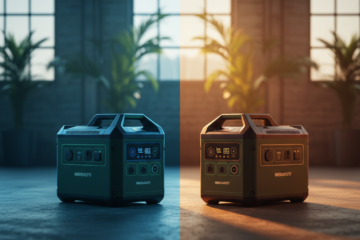
Bluetti AC200L. A 2,048Wh LiFePO4 power station with 2,400W of AC output and expandable capacity. It is the plug and play route to lithium backup: wheel it into place, plug in the fridge and router, done.
Bluetti AC200L Portable Power Station
Jackery Solar Generator 1000 Plus. A 1,264Wh LiFePO4 unit that expands to 5kWh with add on battery packs, so it can grow from weekend backup into a real home bank. It is a good example of how lithium’s modularity has moved into the power station world. We compare more options in our roundup of best portable power stations for home backup.
Jackery Solar Generator 1000 Plus
When Lead Acid Still Wins
An honest comparison has to include this section, because there are real cases where the old technology is the right call:
If none of those describe you, the lithium battery pays for itself on the second or third lead acid replacement it saves you.
FAQ
Q: Is lithium ion really worth the extra upfront cost for home use?
A: For any system that cycles regularly, yes. The cost per cycle math shows LiFePO4 at roughly $0.07 to $0.12 per usable kWh against $0.85 to $1.20 for lead acid. Break even typically arrives with the first lead acid battery you do not have to buy.
Q: How many cycles do lithium batteries last compared to lead acid?
A: Quality LiFePO4 batteries deliver 3,000 to 6,000 cycles to 80 percent capacity, and some are rated higher at shallower discharge. Flooded and AGM lead acid batteries deliver 300 to 500 cycles when discharged to the recommended 50 percent.
Q: Can I replace my lead acid battery with lithium without changing anything else?
A: In most 12V systems, yes. LiFePO4 batteries like the Group 31 model above are drop in replacements. Two checks: make sure your charger or charge controller has a lithium (or adjustable absorb) profile, and confirm your charging source will not charge below freezing unless the battery is heated.
Q: Do lithium batteries work in cold weather?
A: They discharge fine in the cold but standard cells cannot be charged below freezing. Buy a heated LiFePO4 battery or one with a low temperature charging cutoff if the battery lives in an unheated space. Lead acid charges when cold but loses usable capacity and lifespan.
Q: Are lead acid batteries dangerous indoors?
A: Flooded lead acid batteries vent hydrogen while charging and need ventilation; the acid also demands careful handling. Sealed AGM batteries largely solve the gassing problem. Lithium batteries with a proper BMS need no ventilation at all, which is one reason they dominate indoor home installs.
Final Thoughts
In 2026 the lithium ion versus lead acid question is mostly about how you plan to use the battery, not which chemistry is better. LiFePO4 wins on cycle life by a factor of 6 or more, on weight, on efficiency, and on maintenance, and its upfront price premium keeps shrinking. Lead acid hangs on where budgets are tight, duty cycles are light, and simplicity beats performance.
If you are building a bank that will work for a living, start with the LiFePO4 battery above and size it properly with our guide to how to size your home battery system.
Last updated: September 2026