Best 100Ah LiFePO4 Batteries (2026)
By Rowan Watts
Affiliate Disclosure: This post contains affiliate links, including Amazon Associates links. If you buy through our links, we may earn a commission at no extra cost to you. As an Amazon Associate, we earn from qualifying purchases.
A 100Ah LiFePO4 battery has become the default house battery for RVs, vans, boats, and small off-grid solar systems. It stores roughly twice the usable energy of a 100Ah AGM battery with the same rating, weighs about a third as much, and lasts five to ten times longer in cycle testing. The best 100ah lithium battery for your setup depends less on the brand name and more on the details listings tend to bury: BMS rating, cycle life at depth of discharge, low-temperature protection, and case fit.
This guide compares five 100Ah LiFePO4 batteries in five roles: a connected all-rounder, a self-heating pick for sub-freezing trips, a budget workhorse, a marine specialist, and a complete off-grid kit. Every listing was checked live on Amazon at the time of writing, with specs drawn from manufacturer pages. If you are still weighing lithium against an existing lead-acid bank, our guide to the best 12V deep cycle battery for solar covers the AGM side of that decision.
Quick Picks: Best 100Ah LiFePO4 Batteries at a Glance
| Product | Best For | BMS Rating | Cycle Life | Check Price |
|---|---|---|---|---|
| LiTime 12V 100Ah Group 27 Bluetooth | Overall RV and van use | 100A | 4,000+ at 100% DOD | Check Price on Amazon |
| Renogy 12V 100Ah Self-Heating Mini | Sub-freezing camping | 100A | 5,000+ at 80% DOD | Check Price on Amazon |
| Redodo 12V 100Ah Group 31 | Budget house power | 100A | 4,000+ at 100% DOD | Check Price on Amazon |
| Power Queen 12V 100Ah Low-Temp Group 31 | Trolling motors and marine | 100A | 4,000+ at 100% DOD | Check Price on Amazon |
| Dakota Lithium 12V 100Ah Solar Bundle | Complete off-grid kit | Built-in BMS | 2,000+ | Check Price on Amazon |
The 5 Best 100Ah LiFePO4 Batteries
1. LiTime 12V 100Ah Group 27 Bluetooth: Best Overall
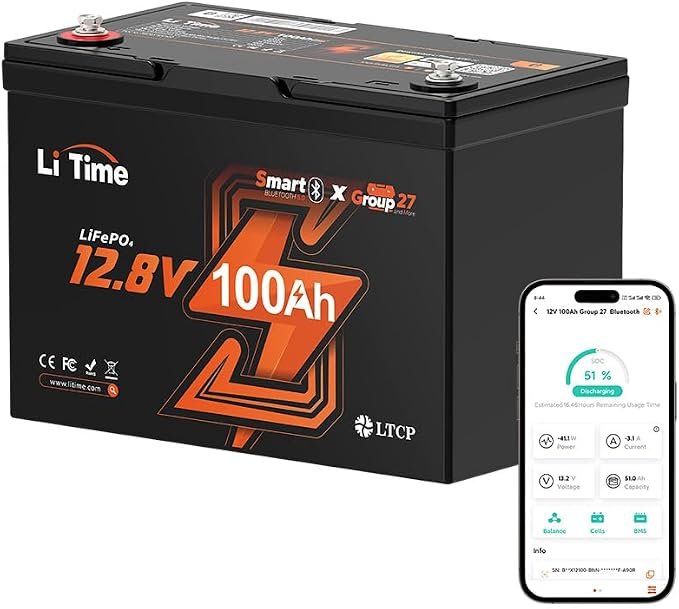
The LiTime 12V 100Ah Group 27 Bluetooth battery earns the top slot by combining the features RV owners actually use. Bluetooth 5.0 connects to the LiTime app for real-time state of charge, voltage, and current, removing the need for a separate shunt. The case is a true Group 27 footprint (about 12.1 by 6.8 by 8.9 inches per the manufacturer), so it drops into many existing compartments, and LiTime states it also fits Group 27 to Group 31 boxes.
Electrically it is conservative in the right ways. The 100A BMS delivers 1,280Wh of nominal capacity with a 500A one-second surge rating, and the protection list covers over-charge, over-discharge, over-current, and moisture or salt-spray exposure in an IP65 housing. LiTime rates the EV-grade cells at 4,000+ cycles at 100 percent depth of discharge, and 4P4S expansion to 20.48kWh is supported. Low-temperature protection is a cutoff rather than a heater: charging stops below 32°F and resumes automatically at 41°F, while discharge works down to -4°F.
The honest caveats: there is no heating element, so you cannot charge in hard freezing the way the Renogy below allows, Bluetooth requires activation with a compatible charger after the battery sits switched off, and LiTime excludes starting, golf cart, and jack applications.
Pros
- Bluetooth 5.0 app monitoring without an extra shunt
- True Group 27 size fits many existing compartments
- 100A BMS with 500A surge and IP65 housing
- 4,000+ cycles at 100 percent DOD with 4P4S expansion support
- Low-temp cutoff blocks charging below freezing rather than heating the cells
- Bluetooth needs reactivation through a charger after extended off periods
- Not rated for engine starting, golf carts, or jacks
- Dual 110W heating pads enable charging in hard freezing conditions
- Rated to 5,000+ cycles at 80 percent DOD
- 21.4 pounds in a compact Group 22NF case
- IP65 weather resistance with a -22°F to 131°F operating range
- Group 22NF size does not fit standard Group 27 or 31 compartments
- Heating consumes charge while warming in the cold
- No Bluetooth or app monitoring on this model
- Standard Group 31 drop-in size for AGM replacements
- 4,000+ cycles at 100 percent DOD with certifications to match
- IP65 housing with a heat-reflective white shell
- Priced below most name-brand equivalents
- No low-temperature charge protection listed
- No Bluetooth or monitoring app
- Support runs through the importer, not a domestic network
- TVS surge protection for trolling motors up to 120 lb thrust
- ABYC E-13 compliant with salt-spray resistant BMS protection
- Clear low-temp cutoffs: charge off below 32°F, discharge off below -4°F
- 4,000+ cycles at 100 percent DOD in a standard Group 31 case
- No heating, so charging below freezing is blocked
- No Bluetooth monitoring
- 100A BMS limits continuous inverter loads to about 1,280W
- Complete system: battery, 1500W inverter, Victron Smart Shunt, and controller included
- 11-year warranty, the longest in this guide
- US-based customer and technical support
- Rated for discharge down to -20°F
- 2,000+ cycle rating trails the rest of this field
- Bundle costs much more than a standalone battery
- Redundant components if you already own an inverter or controller
- Best 12V Portable Refrigerators for Camping: the load that will define how much 100Ah capacity you need.
- What Size Charge Controller Do You Need for a 100W Solar Panel?: the charging math behind a small solar setup.
Cons
2. Renogy 12V 100Ah Self-Heating Mini: Best for Cold Weather
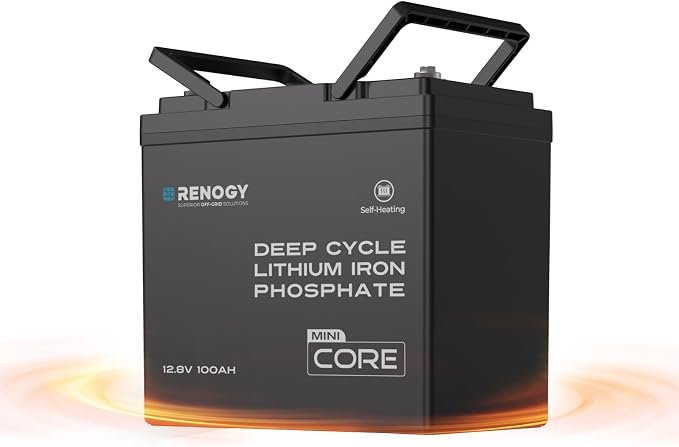
Cold is where most lithium batteries refuse to work, and the Renogy 12V 100Ah Self-Heating Mini is built for that problem. Two internal heating pads deliver 110W of warmth, which Renogy says warms the pack about 40 percent faster than single-pad designs and brings it to charge-ready status in roughly an hour even starting from -22°F. If you winter camp, ice fish, or store a trailer unheated, that is the difference between a battery you can use in January and an expensive paperweight.
The rest of the spec sheet holds up. The 100A BMS carries more than 25 protections, the IP65 case is rated from -22°F to 131°F, and Renogy rates the Grade-A cells at 5,000+ cycles at 80 percent depth of discharge. The other distinguishing feature is size: at 21.4 pounds in a Group 22NF footprint, Renogy claims it is about 45 percent smaller than comparable 100Ah lithium batteries, which matters in teardrop trailers, van builds, and cramped battery bays.
Trade-offs to weigh: the mini case will not fit applications that need a Group 27 or 31 form factor, heating draws on the battery itself when charging in the cold, and this version has no Bluetooth monitoring. For sizing the rest of the system around it, our guide to building a complete RV solar system with batteries is the next step.
Pros
Cons
3. Redodo 12V 100Ah Group 31: Best Value
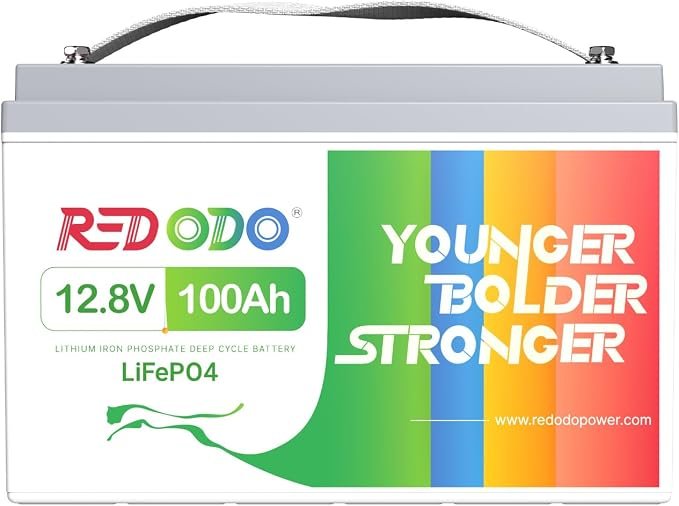
The Redodo 12V 100Ah Group 31 is the straightforward pick: a standard-size, fully specified 100Ah battery at one of the lower prices in the category. It is a drop-in Group 31 replacement for 12V AGM batteries, with EV-grade cells rated at 4,000+ cycles at 100 percent depth of discharge, a 10-year service life claim, and FCC, CE, RoHS, and UN38.3 certifications.
The BMS supplies 100A continuous discharge, enough to run a 1,280W load, covering an inverter, a 12V fridge, lights, and charging gear at once for most users. The housing is IP65 rated for water and dust, and the white shell reflects sunlight rather than absorbing it, which helps keep cells cooler in hot-climate installations. Expansion is supported up to 4P4S, or 20.48kWh, so you can start with one and grow.
What you give up at this price: the listing shows no low-temperature charge cutoff, so in freezing weather you must manage charging temperatures yourself, and there is no Bluetooth monitoring. Support is handled through Redodo rather than a domestic service network, which is worth knowing before you buy.
Pros
Cons
4. Power Queen 12V 100Ah Low-Temp Group 31: Best for Trolling Motors and Marine
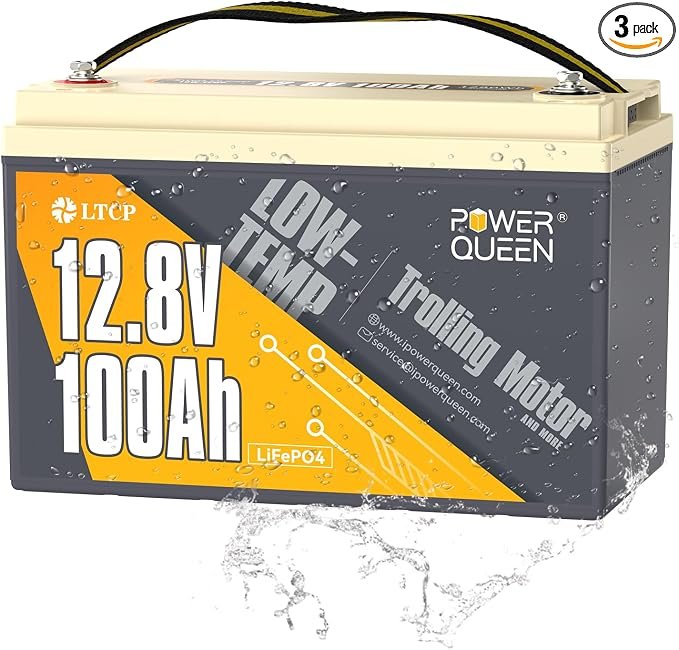
Marine use punishes batteries that are merely adequate on land, and the Power Queen 12V 100Ah Low-Temp Group 31 takes water duty seriously. A TVS surge protector absorbs voltage spikes on 12V to 36V trolling motors up to 120 pounds of thrust, and the triple-protected BMS is rated against dust, water, and salt spray, with ABYC E-13 compliance for marine installations. Those are credentials the budget batteries in this guide do not claim.
Temperature behavior is explicit: charging stops below 32°F and discharge stops at -4°F, protecting the cells from cold-weather damage on the water or in storage. The 100A BMS and 1,280Wh capacity match the rest of this field, the manufacturer rates 4,000+ cycles at 100 percent depth of discharge, and the battery weighs 22.16 pounds in a standard Group 31 case. Expansion to 4P4S is supported if the bank grows.
The limitations: like the LiTime, this is a cutoff design, not a heater, so it will not accept a charge below freezing; there is no Bluetooth monitoring; and the 100A BMS, while ample for trolling and house loads, is not the right fit for large inverter work.
Pros
Cons
5. Dakota Lithium 12V 100Ah Solar Bundle: Best Complete Off-Grid Kit
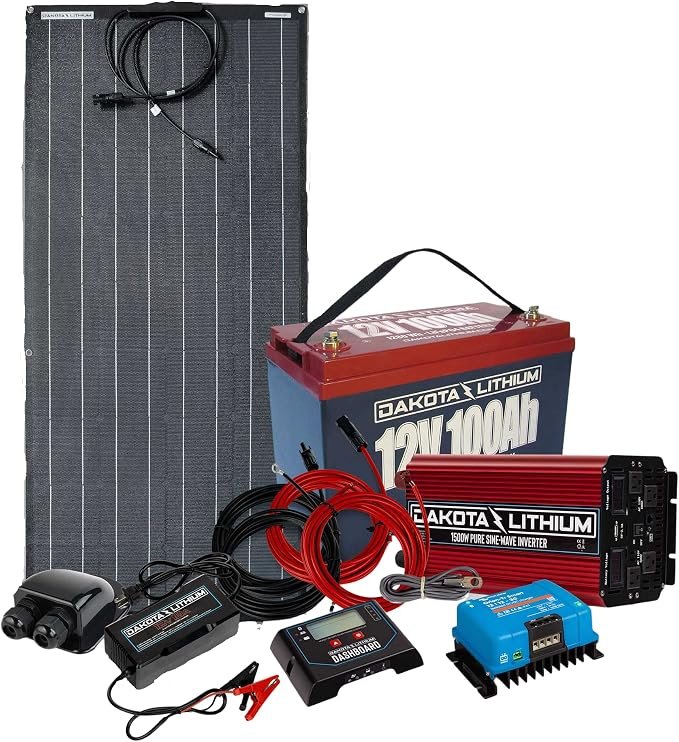
Not everyone starting from zero wants to research five separate components, and the Dakota Lithium 12V 100Ah Solar Bundle ships the whole system in one box: a 100Ah LiFePO4 battery, a 1500W pure sine wave inverter, a Victron Smart Shunt for Bluetooth battery monitoring, and a solar charge controller. For a van, small camper, or cabin build, it collapses a weekend of part-matching into a single purchase with every component speaking the same voltage language.
The battery is rated for 2,000+ cycles in recommended conditions, discharges down to -20°F according to Dakota Lithium, and carries the longest warranty in this guide at 11 years. That warranty, backed by the company’s North Dakota base and US support, is the core reason Dakota commands its premium.
Honest downsides: the cycle rating is lower than every other pick here (2,000+ versus 4,000+), the bundle price is far higher than a bare battery alone, and the included inverter or controller may be redundant if you already own them. This is a convenience purchase, and it is priced like one.
Pros
Cons
Why Upgrade from AGM to LiFePO4?
If you have read our AGM-focused guide to the best 12V deep cycle batteries for solar, the comparison comes down to three numbers. Usable capacity: lead-acid should not be regularly discharged below about 50 percent, so a 100Ah AGM realistically delivers around 50Ah per cycle, while the lithium batteries here deliver close to their full rating. Weight: a 100Ah AGM typically weighs 60 to 70 pounds, while every lithium pick here weighs 21 to 23 pounds. Lifespan: quality LiFePO4 cells are rated for 4,000 to 5,000 cycles against 300 to 500 for AGM.
The counterweights are price and cold behavior. Lithium costs two to three times as much up front, and while the cost per delivered amp-hour over its life is far lower, you pay it today. A standard LiFePO4 battery also cannot accept a charge below freezing without a low-temperature cutoff or heating circuit, something AGM does not care about. Our comparison of lithium ion and lead acid batteries for home use covers the full trade-off.
How to Choose a 100Ah LiFePO4 Battery
Match the BMS to your loads. The BMS rating caps continuous discharge. A 100A BMS supports about 1,280W, enough for most RV house systems and trolling motors, but not for a 2000W or 3000W inverter running a microwave or air conditioner. Check continuous and surge ratings against your biggest simultaneous load.
Read cycle life with its test conditions. A cycle rating is only meaningful with its depth of discharge. A battery rated 5,000+ cycles at 80 percent DOD and one rated 4,000+ cycles at 100 percent DOD are closer than they look. Also weigh warranty length and certifications such as UN38.3.
Decide what cold weather protection you need. There are three tiers in this guide: none (Redodo), low-temperature cutoff (LiTime and Power Queen, charging blocked below 32°F), and active self-heating (Renogy, charging possible in hard freezing conditions). Match the tier to your worst-case camping or storage climate.
Check the case size before you order. Group 24, Group 27, Group 31, and Group 22NF cases are not interchangeable. Measure your battery bay and compare it to the listing dimensions, since the compact Renogy will not fill a Group 31 tray and a Group 31 battery will not fit a Group 24 box.
Plan for expansion. If a second battery is likely, confirm the maximum series and parallel configuration now. Most picks here support 4P4S, but wiring, cable sizing, and controller headroom all matter; for the charging side of that math, our guide on charge controller sizing for a 100W panel covers the calculations.
Frequently Asked Questions
Is a 100Ah LiFePO4 battery enough for an RV?
For a weekend rig running a 12V fridge, lights, water pump, and phone charging, a single 100Ah battery usually lasts a day or two between charges. Add an inverter, rooftop air conditioning, or extended off-grid stays, and most owners move to two or more in parallel.
Can I use a 100Ah LiFePO4 battery as a drop-in replacement for my AGM battery?
Physically, usually yes, if the group size matches. Electrically, you also need a charging source with a lithium-compatible profile, typically 14.2 to 14.6 volts absorption, and no lead-acid equalization mode. Most modern MPPT controllers and lithium-profile converters handle this; older fixed lead-acid chargers may not.
How long will a 100Ah LiFePO4 battery run a 12V fridge?
A typical 12V portable refrigerator draws 40 to 60Ah per day depending on ambient temperature, so a full 100Ah lithium battery, which delivers nearly all of its rated capacity, runs it roughly two days without recharging. That usable-capacity advantage over AGM, which should only be discharged to half, is exactly where lithium earns its price.
Do these batteries include a warranty?
Yes, all five carry manufacturer warranties, from multi-year coverage on the value brands to 11 years on the Dakota Lithium bundle. Read the terms first: cycle ratings, permitted applications, and support location all differ, and some service depends on a distributor rather than a domestic office.
Related Reading
Tags: LiFePO4, 12V battery, deep cycle battery, lithium, RV solar battery, boat power