Best Solar Power Banks (2026)
By Rowan Watts
Affiliate Disclosure: This post contains affiliate links, including Amazon Associates links. If you buy through our links, we may earn a commission at no extra cost to you. As an Amazon Associate, we earn from qualifying purchases.
A solar power bank is a battery pack with a small photovoltaic panel built into its face, sized to top off a phone, headlamp, or GPS unit when you are days from an outlet. Before comparing models, one piece of honesty up front: the panels on these devices are tiny, typically 1 to 6 watts, so they trickle-charge the internal battery rather than refill it. Every manufacturer in this guide says the same thing in its own documentation: you charge the bank from a wall outlet before you leave, and the solar panel exists to claw back a partial charge in an emergency. Treat the solar feature as a safety net, not a primary power source, and these devices make a lot of sense.
With that framing set, we compared five solar power banks across capacity, charging speed, durability, and real-world solar input, verifying specifications against current Amazon listings and manufacturer pages. If your needs outgrow a pocket-sized bank entirely, our guide to the best portable power stations for home backup covers the kilowatt-hour class instead.
Quick Picks: Best Solar Power Banks at a Glance
| Product | Best For | Capacity | Max Output | Solar Input |
|---|---|---|---|---|
| BigBlue BS01 Solar Power Bank 20,000mAh | Best overall, cable-free travel | 20,000mAh (74Wh) | 20W USB-C PD | Emergency trickle only |
| BLAVOR 10,000mAh Wireless (PN-W05) | Best compact, everyday carry | 10,000mAh | 20W USB-C PD + Qi | Emergency trickle only |
| BLAVOR 20,000mAh 4-Panel (PN-W12-Pro) | Best true solar charging | 20,000mAh (74Wh) | 18W USB-C PD | Up to 6W from 4 panels |
| SOXONO 40,000mAh Solar Power Bank | Biggest capacity, base camp | 40,000mAh | 20W PD | Emergency trickle only |
| Durecopow 20,000mAh Solar Charger | Best budget classic | 20,000mAh | 12W (5V/2.4A) | Emergency trickle only |
The 5 Best Solar Power Banks
1. BigBlue BS01 Solar Power Bank 20,000mAh: Best Overall
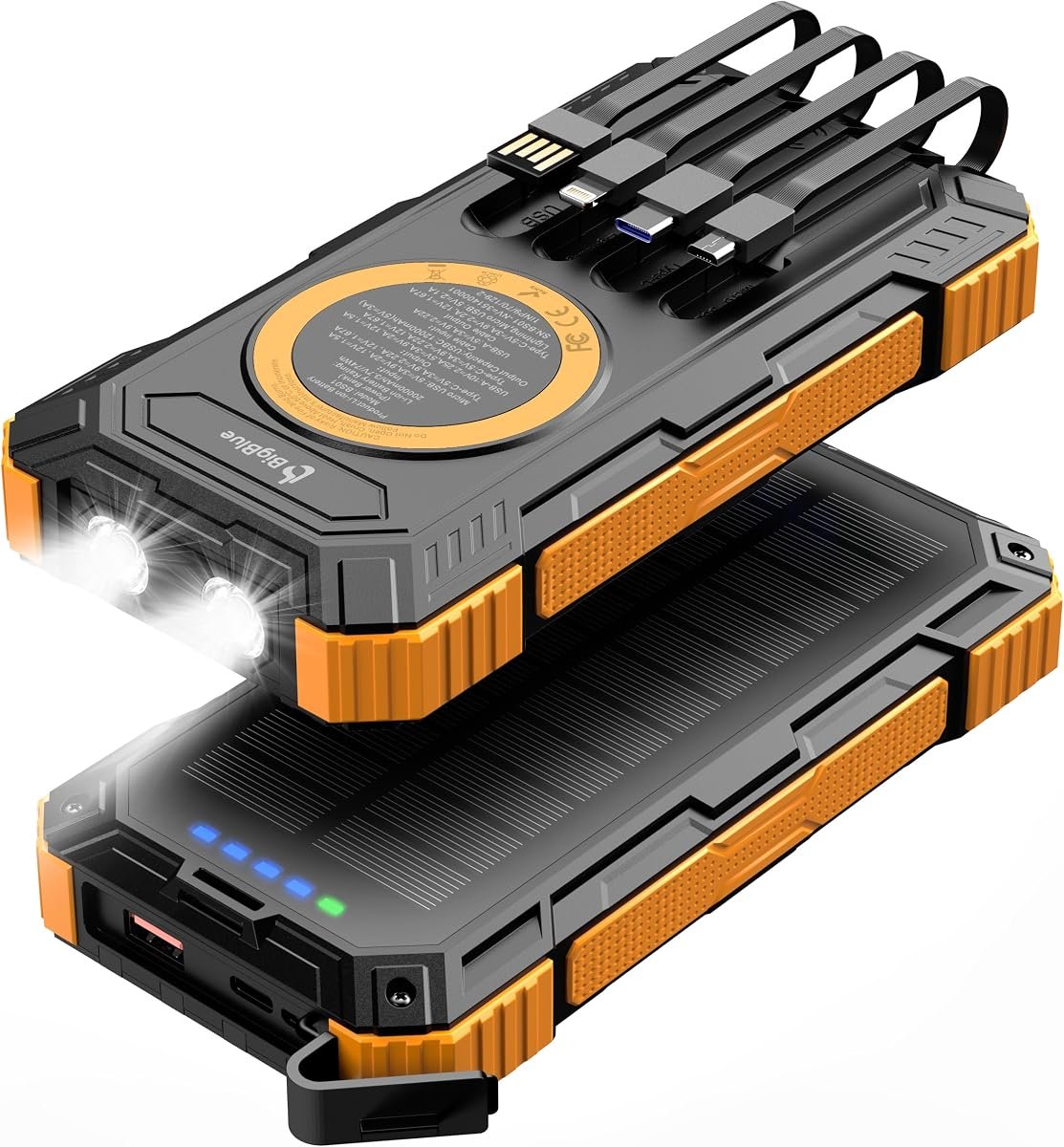
The BigBlue BS01 wins this roundup because it solves the most common failure point of a power bank: the missing cable. It carries three built-in output cables (USB-C, Lightning, and Micro USB) plus a fourth built-in USB-A cable used to recharge the bank itself from any USB-A source. Output tops out at 20W through the USB-C Power Delivery port with 18W QC 3.0 alongside, and BigBlue states the pack can take an iPhone 16 to roughly 50 percent in about 30 minutes.
The 20,000mAh capacity is DEKRA-verified rather than merely claimed, which matters in a category notorious for inflated ratings, and at 74Wh the pack stays under the 100Wh airline limit for carry-on batteries. Pass-through charging lets it refill while feeding a device, and a water-resistant, shock-resistant, dust-resistant shell plus an LED flashlight round out the kit. On the solar side, BigBlue is blunt in its own listing: the panel is designed for emergency use only, so while it may add a small buffer to a drained battery over a long sunny day, a full refill from empty via solar alone is not realistic. Charge it from the wall before a trip, and let the panel be your backup. The honest drawbacks: the built-in cables cannot be replaced if one fails, so a damaged cable means replacing the whole unit; there is no wireless charging pad at this price point; and the 20W ceiling is fine for phones and tablets but will not meaningfully run larger USB-C devices.
Pros
- Four built-in cables including a self-recharge USB-A cable, so no cords to pack
- DEKRA-verified 20,000mAh capacity with 74Wh airline-compliant rating
- 20W USB-C PD output with pass-through charging
- Integrated cables are not replaceable if one breaks
- Solar panel is explicitly an emergency-only trickle source
- No wireless charging, and 20W output will not run larger devices
- Compact and light for its class, easy everyday carry
- Qi wireless pad plus two USB ports for three simultaneous devices
- IPX5 waterproof, dustproof, shockproof with dual flashlights and compass
- 10,000mAh covers only about two phone refills
- Wireless charging is slow and generates heat
- Solar panel adds only a small trickle in full sun
- Four foldable panels with a verified 6W maximum solar input, best in this guide
- PD 18W USB-C plus QC 3.0 with three simultaneous outputs
- Camping light, SOS flashlight, compass, and built-in USB-C cable lanyard
- Hinged panels add bulk and are a wear point over time
- 18W output is dated next to 20W rivals
- Even 6W means days, not hours, for a full solar refill
- 40,000mAh capacity, roughly 5 to 7 phone charges in one pack
- PD 20W fast charging with 4 built-in cables and 3 ports
- Dual flashlights with 4 modes and up to 30 hours of stated runtime
- Exceeds the 100Wh airline battery limit, not flyable
- Solar panel is negligible against a 40,000mAh battery
- Heavier and bulkier than every other pick here
- Lowest-priced 20,000mAh pick with 4 built-in cables and 3 ports
- Rugged rubberized shell with carabiner, compass, and dual flashlights
- CE, FCC, RoHS certified with a stated 1,000+ cycle battery life
- 5V/2.4A output is slow next to 20W PD rivals
- Smallest solar panel in the guide, barely a trickle
- Warranty support comes from a small importer, not an established brand
- Best Portable Power Stations for Home Backup: when a power bank is not enough.
- Best Solar Generators for Camping: panel-plus-battery kits that charge properly from the sun.
- Best 12V Solar Battery Chargers and Maintainers: solar trickle charging at a scale that works.
Cons
Check Price on Amazon: BigBlue BS01 Solar Power Bank 20,000mAh
2. BLAVOR 10,000mAh Wireless Solar Power Bank: Best Compact Pick
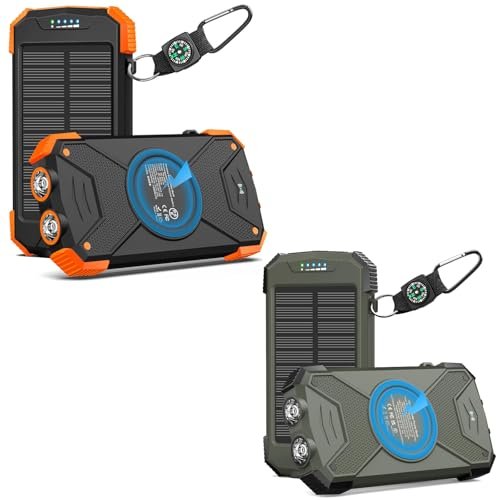
The BLAVOR PN-W05 is the bank that lives in a daypack and gets taken everywhere, because at 10,000mAh it stays small and light while still carrying the full outdoor feature set. You get 20W USB-C Power Delivery wired charging, a Qi wireless pad on the face of the unit (retailer spec sheets list it at up to 7.5W for compatible phones), and dual USB ports, so up to three devices can charge at once. BLAVOR rates the housing IPX5 waterproof, dustproof, and shockproof, and equips it with dual super-bright flashlights plus a compass carabiner.
This is the longest-running design in the guide, and it has outlasted dozens of imitators for a reason: the feature-to-size ratio is hard to beat for hikers and travelers who mainly need one to two phone refills. Capacity is the honest limit. 10,000mAh is roughly one and a half to two full phone charges depending on the handset, so tablet users and multi-day groups will feel the ceiling quickly. The wireless pad is convenient but slow compared with the wired port and adds heat during charging. And like every bank here, the small panel is a trickle charger, not a refill mechanism; BLAVOR’s own guidance is to top the unit up from an outlet before departure. If you want the same formula with more endurance, the 20,000mAh BLAVOR below doubles the battery.
Pros
Cons
Check Price on Amazon: BLAVOR 10,000mAh Wireless Solar Power Bank
3. BLAVOR 20,000mAh with 4 Foldable Solar Panels: Best True Solar Charging
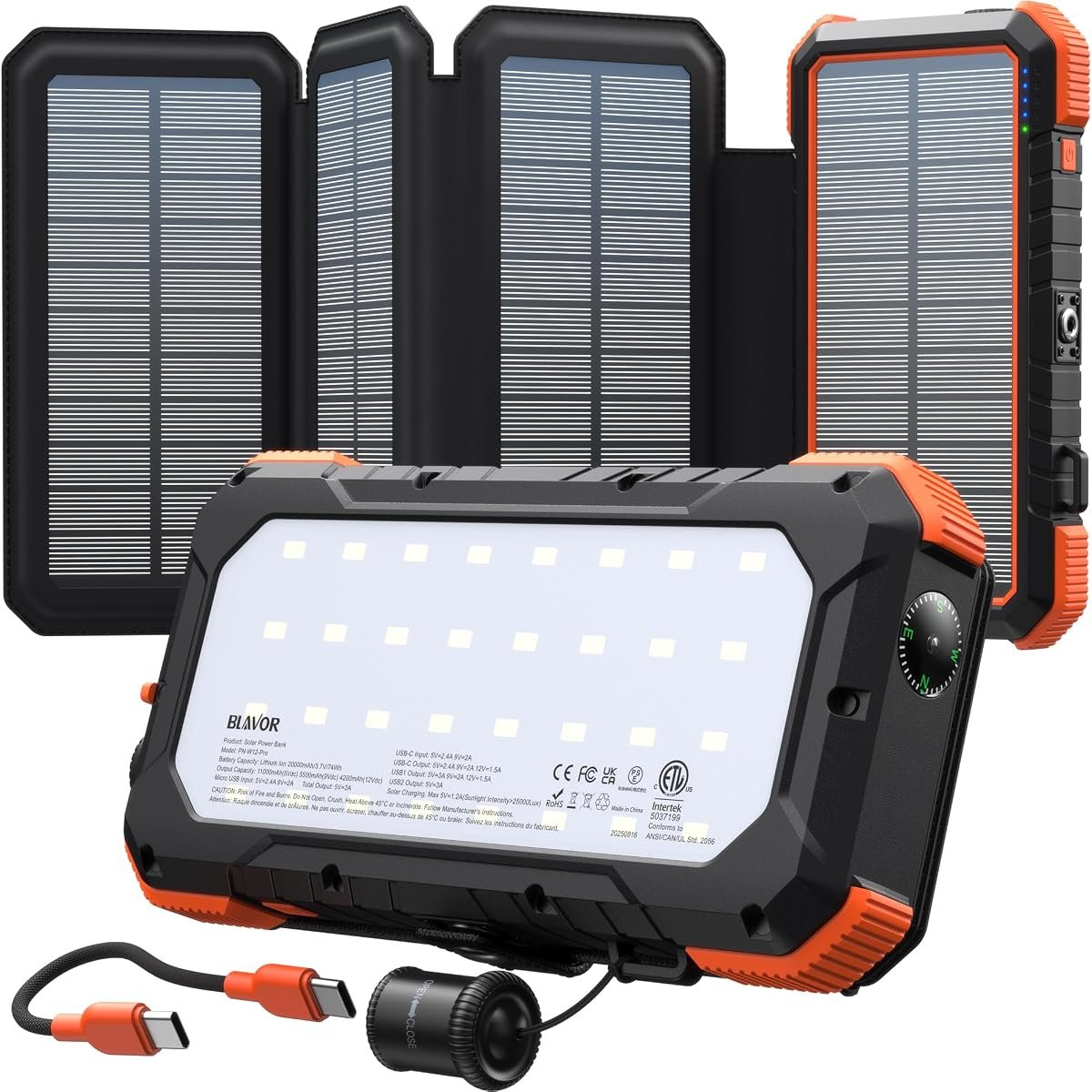
Every flip-open panel bank promises faster solar charging; the BLAVOR PN-W12-Pro is the one that publishes the numbers. Its four foldable panels produce up to 5V at 1.2A, or about 6W, in sunlight above 25,000 lux, which BLAVOR rates as six times the solar input of a single-panel bank. Six watts is still modest in absolute terms: refilling the full 74Wh battery from sunlight alone would take roughly 12 to 13 hours of ideal peak sun, meaning several good days in the field. But it is enough to make a real dent in a depleted bank over a sunny day at camp, which no single-panel unit here can honestly claim. It remains true to the category, though: wall charging is primary, solar is the recovery tool.
The rest of the specification is solid. PD 18W USB-C output with QC 3.0, three outputs (two USB-A plus one bidirectional USB-C), a built-in USB-C to USB-C cable integrated into the carry lanyard, a UL2056-certified lithium-polymer cell, IPX5 weather resistance, and a dual light system combining a 3-level camping light with a 3-mode flashlight (torch, SOS, strobe). A compass and carabiner complete the package. The tradeoffs: the four-panel hinge mechanism adds bulk and is one more mechanical part to wear or break; 18W output trails the 20W units in this guide; and the fold-out panels must be manually oriented toward the sun to deliver their rated input, so half-hearted panel placement yields far less than 6W.
Pros
Cons
Check Price on Amazon: BLAVOR 20,000mAh Solar Power Bank with 4 Foldable Panels
4. SOXONO 40,000mAh Solar Power Bank: Biggest Capacity
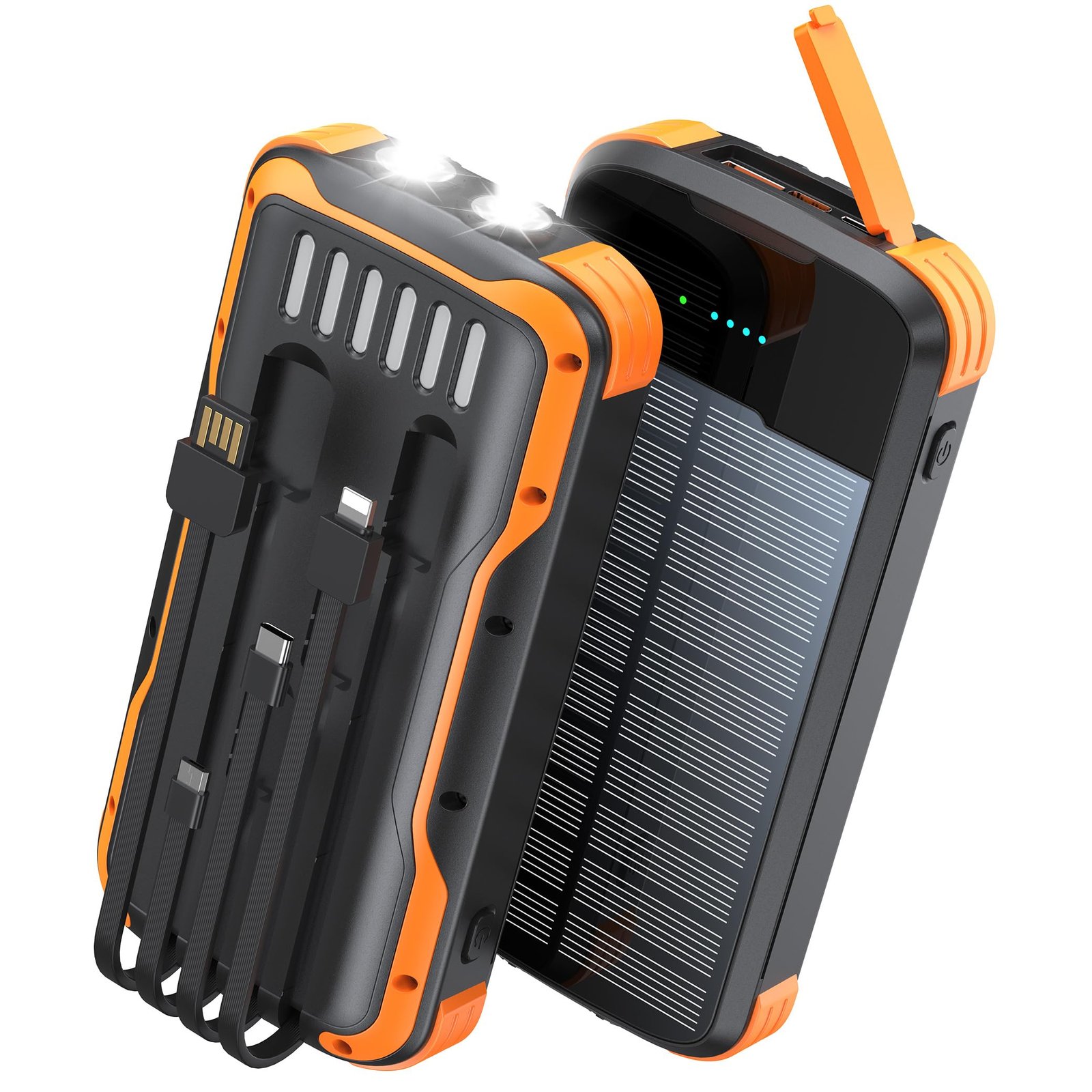
The SOXONO L24S is the pack you bring when leaving the grid for a week and weight matters less than endurance. Its 40,000mAh lithium-polymer battery is double the capacity of the other picks here, which SOXONO rates at five to seven full phone charges, with enough left over for tablets, headphones, cameras, and small USB accessories. Charging is PD 20W fast, with four built-in cables and three ports so a whole group of devices can feed at once. The dual LED flashlights are genuinely useful, with four modes (steady, SOS, strobe, and low), a manufacturer-stated runtime of up to 30 hours, and a 3W, 300-lumen LED.
Two honest caveats deserve emphasis before you buy. First, this pack stores roughly 148Wh of energy, our computation from 40,000mAh at the standard 3.7V nominal cell voltage; SOXONO publishes no Wh rating, and even at a conservative 3.0V the figure is about 120Wh, so it exceeds the 100Wh lithium battery limit that airlines set for carry-on and checked baggage. It is not a travel bank; it is a car-camping, cabin, and emergency-kit bank. Second, its capacity makes the trickle-charge problem worse, not better: the built-in panel, which SOXONO specs at 5.5V/300mA (about 1.65W), refills a vanishingly small fraction of a 40,000mAh battery per sunny day, so this unit must live its life charged from the wall, with solar as a symbolic assist in emergencies. It is also a heavier, bulkier unit by necessity, though it is the least expensive per amp-hour in this guide. Buy it for capacity and cable convenience, not for its solar credentials.
Pros
Cons
Check Price on Amazon: SOXONO 40,000mAh Solar Power Bank
5. Durecopow 20,000mAh Solar Charger Power Bank: Best Budget Classic
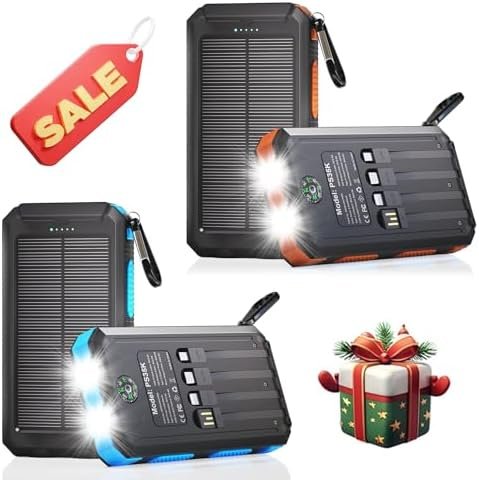
The Durecopow has been the default sub-35-dollar solar charger on Amazon for years, and the current version keeps the formula while modernizing the cable situation: three built-in output cables (USB-C, Lightning, and Micro USB) plus a built-in USB-A input cable, alongside a USB-C port and two USB-A ports, for up to six devices at once. The rubberized ABS shell is drop-resistant, dustproof, and water-resistant, with a carabiner and compass included, five LED indicator lights, and dual flashlights with steady, SOS, and strobe modes. The listing states CE, FCC, and RoHS certification and more than 1,000 recharge cycles.
What the low price buys in convenience it gives back in speed. Output runs at 5V/2.4A, about 12W, with no Power Delivery or Quick Charge negotiation, so modern phones charge noticeably slower than on the 20W picks above. The panel appears to be a 1W-class trickle (Durecopow publishes no wattage figure for it), the smallest solar contribution in this guide, which Durecopow’s own manual acknowledges by recommending a full wall charge before any trip. The brand’s warranty language, including a very long service window, is generous on paper but comes from a small importer rather than an established power brand, so set expectations accordingly. As a glovebox and emergency-kit bank, or a first solar charger for a kid’s camping kit, it remains an easy recommendation; as a fast daily driver, it is not.
Pros
Cons
Check Price on Amazon: Durecopow 20,000mAh Solar Charger Power Bank
How We Chose
We started from the category’s central constraint: the solar panel. Any honest roundup of solar power banks has to acknowledge that panels this small, typically 1 to 6 watts, cannot refill a 74Wh to 148Wh battery in anything close to a day of sun. (Watt-hour figures here are calculated at the standard 3.7V nominal cell voltage unless the manufacturer publishes its own rating.) So we weighted the comparison toward the things that matter every single day: verified battery capacity, real charging output, cable convenience, weather resistance, and lighting, while treating solar input as the tiebreaker it honestly is. Specifications were checked against current Amazon listings and manufacturer documentation, and we excluded models with inflated capacity claims or unverifiable output figures. Every pick states its solar limitation plainly. If you want to understand how small-panel trickle charging differs from a real 12V solar setup, our guide to 12V solar battery chargers and maintainers covers the same physics at a scale that actually works.
How to Choose a Solar Power Bank
Buy capacity for the wall, not the panel. Size the battery to your real device load. A 10,000mAh bank handles one to two phone refills; 20,000mAh covers a weekend per person; 40,000mAh is for groups, tablets, or a week off-grid. Remember the airline rule: batteries over 100Wh are not permitted on flights, and 40,000mAh units exceed that at roughly 148Wh (computed at the standard 3.7V nominal cell voltage; manufacturers rarely publish Wh ratings).
Check the output wattage, not the amp-hours alone. A 20W USB-C PD port charges a modern phone about twice as fast as a 5V/2.4A port. If your phone, tablet, or laptop supports Power Delivery, the 18W to 20W picks in this guide are worth the small premium over legacy 12W units.
Read the solar claims skeptically. Manufacturers that state “emergency use only” are being straight with you. Foldable multi-panel designs like the BLAVOR PN-W12-Pro genuinely charge several times faster than single-panel units, but even 6W means days in the sun for a full refill. Nobody selling a pocket bank can honestly promise more.
Weight and weather rating matter outdoors. IPX5 ratings on the BLAVOR units mean splash and rain resistance, not submersion. Larger banks trade weather sealing for capacity, so match the shell to your activity: sealed and light for hiking, bigger and more capable for car camping.
Use the lights and extras. Dual flashlights with SOS and strobe modes have real emergency value, and a built-in cable means you are never stranded without a cord. These features cost little and earn their space in a kit that lives in a pack. For whole-home resilience beyond pocket devices, see our guide to home battery backup without solar.
Frequently Asked Questions
Do solar power banks actually work?
Yes, but with a major caveat. The battery, ports, and build quality work exactly like any power bank. The solar panel works too, but it is tiny, typically 1 to 6 watts, so it trickle-charges the battery rather than refilling it. Expect the panel to recover a useful partial charge over a full sunny day, not a full recharge. Charge the bank from a wall outlet as your primary method and treat solar as the backup.
How long does it take to charge a solar power bank with the sun?
Realistically, several days. A 20,000mAh bank stores about 74Wh, and a typical built-in panel delivers 1W to 6W under ideal sun. At 6W, a perfect full-sun day contributes roughly 25Wh to 30Wh, so a complete refill from empty takes multiple excellent days, longer with real-world clouds and panel angles. Wall charging takes a few hours and should always be your starting point.
Can I take a solar power bank on a plane?
Banks at or under 100Wh are allowed in carry-on baggage, which covers all 10,000mAh and 20,000mAh models in this guide. Banks around 40,000mAh store roughly 148Wh, a computed figure based on the standard 3.7V nominal cell voltage; even at a conservative 3.0V they hold about 120Wh, so they exceed the 100Wh limit and are not permitted on commercial flights. Large banks also cannot go in checked luggage under any circumstances; lithium spare batteries are carry-on only.
What can a solar power bank charge?
Phones, tablets, headphones, smartwatches, cameras, headlamps, and other USB devices. With 18W to 20W USB-C Power Delivery, some small laptops can accept a partial charge. What they cannot do is run appliances, inverters, or anything drawing more than a few dozen watts; that is portable power station territory.
Are expensive solar power banks worth it?
The price premium generally buys verified capacity, faster PD output, better weather sealing, and stronger warranty support rather than better solar panels, since panel physics caps what any of them can harvest. The 20,000mAh class at the mid-range price point is the sweet spot for most buyers; budget models trade charging speed and brand support, not solar performance.
Tags: solar energy, portable power, camping power, emergency power, energy storage, DIY solar