Best Pure Sine Wave Inverters (2026)
By Rowan Watts
Affiliate Disclosure: This post contains affiliate links, including Amazon Associates links. If you buy through our links, we may earn a commission at no extra cost to you. As an Amazon Associate, we earn from qualifying purchases.
An inverter decides whether your electronics run clean or complain. A pure sine wave inverter reproduces the smooth waveform of utility grid power, the waveform laptops, CPAP machines, and refrigerator compressors expect. Modified sine units cost less, but their choppy output can make motors hum, chargers run hot, and some devices refuse to power on at all.
This guide compares five pure sine wave inverters across the sizes that matter most: a 300W car unit, a 1500W mid-size converter, a premium 1200VA option, and two 2000W inverters built for RV and solar duty. Every specification was verified against the listing or manufacturer documentation, and every pick has honest downsides. If you still need the battery bank to feed one of these, start with our guide to the best 12V deep cycle batteries for solar.
Quick Picks: Best Pure Sine Wave Inverters at a Glance
| Product | Best For | Continuous / Surge | Outlets and Ports | Check Price |
|---|---|---|---|---|
| BESTEK 300W Pure Sine Wave Inverter | Road trips, laptops, phone charging | 300W / 700W | 2 AC outlets, 4.8A dual USB | Check Price on Amazon |
| WZRELB 1500W Pure Sine Wave Inverter | Budget power for tools and appliances | 1500W / 3000W | 2 AC outlets | Check Price on Amazon |
| Victron Phoenix 12/1200 | Premium builds, low idle draw, monitoring | 1200VA (about 1000W) / 2200W peak | 1 NEMA 5-15 GFCI outlet | Check Price on Amazon |
| Renogy P2 2000W Pure Sine Wave Inverter | RV and off-grid solar systems | 2000W / 4000W | 3 AC outlets, hardwire block, 5V/2.1A USB | Check Price on Amazon |
| GIANDEL 2000W Pure Sine Wave Inverter (GFCI) | Safety-first installations with GFCI protection | 2000W / 4100W | UL-listed 20A GFCI outlets, 36W USB-C | Check Price on Amazon |
The 5 Best Pure Sine Wave Inverters
1. BESTEK 300W Pure Sine Wave Inverter: Best for Road Trips and Small Electronics
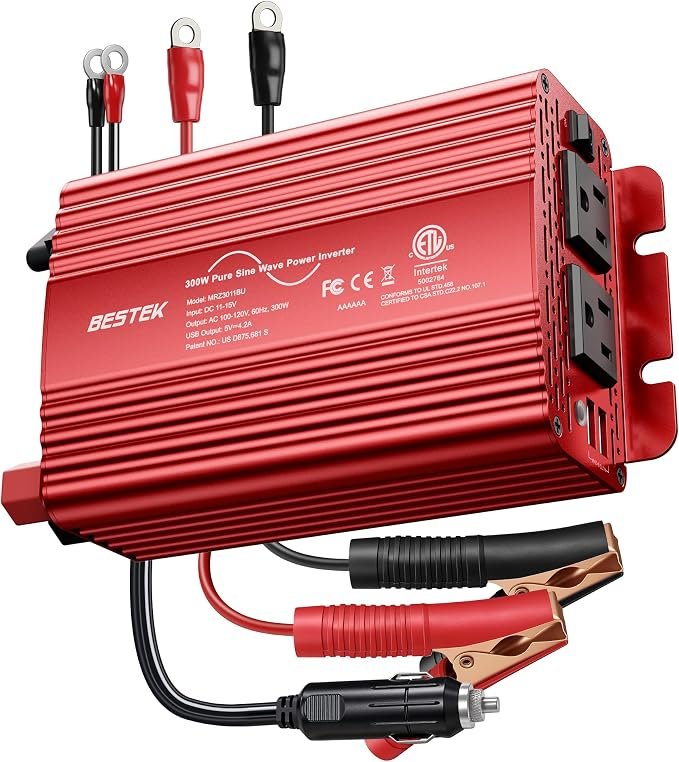
The BESTEK 300W (model MRZ3011BU) is the easiest entry into pure sine power. It converts 12V DC to 110V AC with a genuine sine wave output, rated for 300 watts continuous and 700 watts peak, confirmed in the listing’s spec table at 60 Hz.
Connectivity is simple: two AC outlets and a 4.8A dual USB section. Power it from a cigarette lighter plug or clamp the included alligator clips onto a battery. An isolated protection circuit covers over-voltage, under-voltage, overheating, overload, reverse polarity, and short circuit, and the metal housing shrugs off road-trip abuse. BESTEK backs it with an 18-month replacement warranty.
The honest catch is capacity: a typical vehicle 12V socket is fused around 15 amps, and BESTEK advises keeping lighter-plug loads under 150 watts. To use the full 300W rating, you need the battery clamps.
Pros
- True pure sine output in the cheapest, smallest format on this list
- 700W peak handles motorized start-ups like an electric pump
- Cigarette plug and alligator clamps included, plus 4.8A dual USB
- Metal housing and a long protection list for the price
- 300W covers electronics only; keep lighter-socket loads under 150W per BESTEK’s guidance
- No hardwire terminals, so it cannot grow with a permanent system
- 12V systems only
- Full 1500W continuous output at a mid-size price
- Dual LED readouts for both DC input and AC output voltage
- Temperature-controlled fan instead of a noisy always-on design
- Ground leakage protection, rare at this price point
- 12-month warranty is the shortest in this guide
- No USB charging, no remote control, no hardwire terminal block
- Output voltage can drift under heavy load per the manual
- About 1W standby draw in ECO mode, the lowest idle here by a wide margin
- NEMA 5-15 GFCI outlet with clean, tightly regulated sine wave output
- VE.Direct port integrates with Victron’s monitoring ecosystem
- Five-year manufacturer warranty
- One AC outlet limits multi-device use without extra hardware
- Costs more than the 2000W picks while delivering less continuous power
- Full monitoring requires additional Victron hardware
- 2000W continuous and 4000W surge covers microwaves and most power tools
- Above 90 percent conversion efficiency, ETL listed
- Ships with 4 AWG cables, hardwire block, and a wired remote
- Three AC outlets plus USB in one chassis
- One-year warranty, shortest of the two 2000W picks
- No LCD or USB-C; monitoring is limited to the remote’s indicators
- Large and heavy, at 17.5 by 8.7 by 3.7 inches and 11.7 pounds
- UL-approved 20A GFCI outlets for wet and outdoor environments
- LCD reporting of load watts, voltages, and protection codes
- 36W USB-C PD charges modern laptops without an adapter
- 15-foot wired remote with battery monitor included
- 18-month warranty, far short of the Victron’s coverage
- GFCI receptacles can nuisance-trip on some loads with leaky filters
- 12V input only; 24V battery systems need a different model
- Best 12V Deep Cycle Batteries for Solar: the battery banks that feed these inverters.
- Complete RV Solar System with Batteries: where a 2000W inverter fits in a full build.
- Best 12V Portable Refrigerators for Camping: the biggest load most mobile systems face.
- How to Size Your Home Battery System: the storage-side math in more depth.
Cons
2. WZRELB 1500W Pure Sine Wave Inverter: Best Mid-Size Value
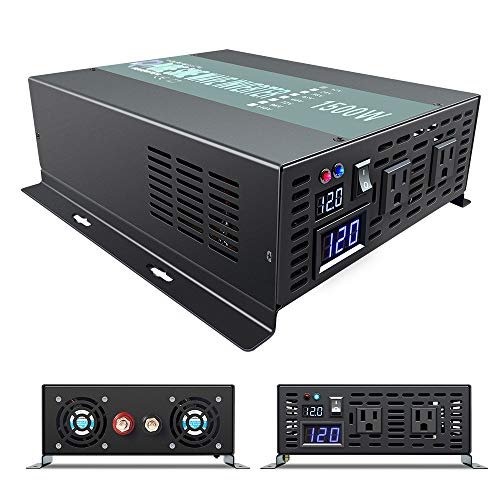
WZRELB has built off-grid inverters for years, and the RBP-1500S is the brand’s workhorse: 1500 watts continuous, 3000 watts peak, converting 12V DC to 120V AC at 60 Hz with a listed pure sine waveform and pure copper filter inductors.
Dual LED displays show both DC battery voltage and AC output voltage, so you can spot a sagging battery before it trips the low-voltage cutoff. The cooling fan is temperature-controlled rather than load-controlled, cycling on above 50 degrees Celsius, which keeps it quieter. Protection covers over-voltage, low voltage, overload, short circuit, overheating, reverse polarity (via fuse), and ground leakage.
Where you save money is on finish and warranty. The warranty is 12 months, half of what BESTEK and GIANDEL offer. There is no USB port, no remote, and the manual notes output voltage can drift under heavy load and may need a trim adjustment.
Pros
Cons
3. Victron Phoenix 12/1200: Best Premium Pick for Serious Systems
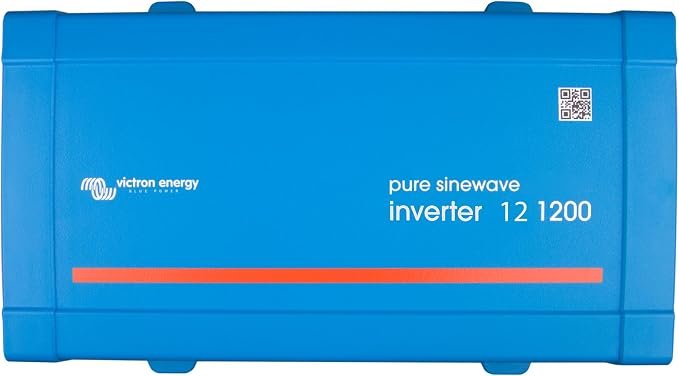
Victron Energy is the brand you graduate to when reliability matters more than watts per dollar. The Phoenix 12/1200 (120VAC version with NEMA GFCI) delivers 1200VA of continuous pure sine output, about 1000 watts at 25 degrees Celsius (850W at 40 degrees), with a 2200W peak for motor start-up.
Its standout feature is idle behavior. Most inverters burn 10 to 20 watts around the clock, silently draining a battery bank. The Phoenix’s ECO mode drops standby draw to about 1 watt, waking fully when a load appears. The VE.Direct port connects to Victron’s monitoring ecosystem so you can log loads and battery behavior, and Victron backs the Phoenix line with a five-year warranty, the longest here.
The tradeoffs: you get a single GFCI-protected NEMA 5-15 outlet, so multi-appliance setups need a power strip. There is no USB charging. And you pay a substantial premium over the 2000W units below for 1000 watts of output.
Pros
Cons
4. Renogy P2 2000W Pure Sine Wave Inverter: Best for RV and Off-Grid Solar
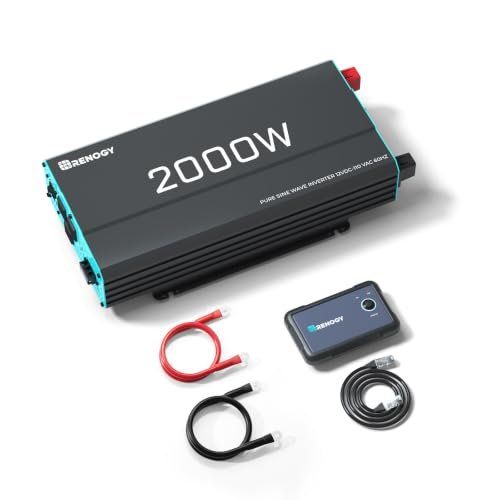
The Renogy P2 (part number RNG-INVT-2000-12V-P3) is the default choice in DIY RV solar: 2000 watts continuous, 4000 watts peak surge, 12V input to 120V output, with conversion efficiency above 90 percent. It is ETL listed, important when wiring roughly 185 amps of DC current.
Installers get a sensible kit: two 4 AWG three-foot battery cables, an AC terminal block for hardwiring circuits, three AC outlets, a 5V/2.1A USB port, and a wired remote. Renogy recommends feeding it from a deep-cycle battery bank, not a starter battery.
The downsides are typical of a value 2000W unit: the warranty is one year, thin for this class of hardware. There is no display or USB-C, and at 11.7 pounds and 17.5 inches wide it needs a real mounting plan. A 2000W draw also flattens a modest battery bank fast.
Pros
Cons
5. GIANDEL 2000W Pure Sine Wave Inverter with GFCI: Best Safety-First 2000W Pick
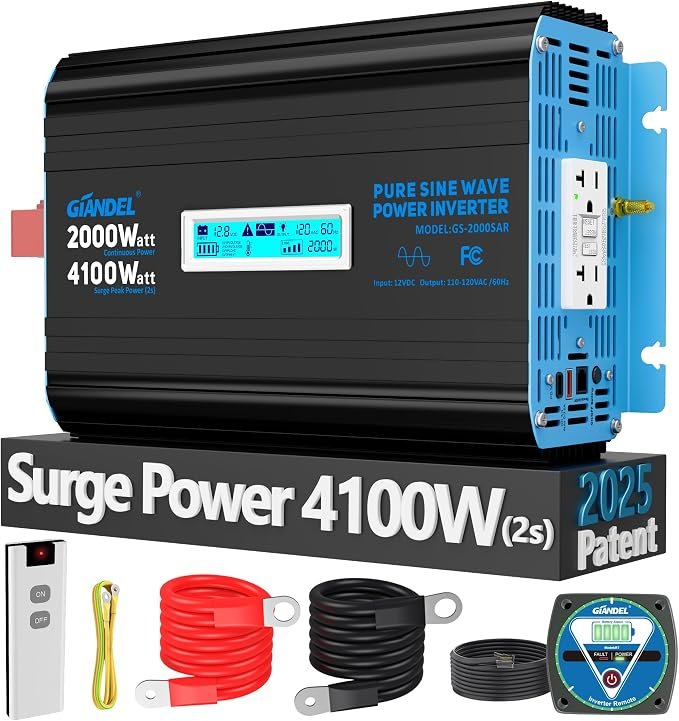
The GIANDEL GS-2000SAR-GFCI matches the Renogy’s headline numbers, with 2000 watts continuous and a 4100W surge held for two seconds, and pulls ahead on monitoring and shock protection. The LCD shows input voltage, output wattage, battery status, and a protection code when something trips. Its outlets are UL-approved 20-amp GFCI receptacles, the same ground-fault protection required in kitchens and bathrooms, a meaningful upgrade wherever inverter power meets moisture.
The rest of the package is competitive: a 36W USB-C power delivery port, a 15-foot wired remote with battery monitor, and an aluminum housing with covered input terminals. Main components including the PCB, fuses, and transformers are UL approved, and the fan only runs when internal temperature or load level calls for it. The 18-month warranty beats the Renogy’s but trails Victron’s five years, and GIANDEL recommends pairing it with roughly a 200Ah battery bank.
Pros
Cons
Pure Sine vs Modified Sine: Why the Waveform Matters
Utility power is a smooth, continuously varying sine wave. A pure sine wave inverter reproduces that shape, while a modified sine inverter approximates it with a stepped, blocky waveform. The difference shows up in three places.
First, motors. Induction motors in refrigerators, fans, and pumps run hotter, buzz louder, and lose efficiency on modified sine power, shortening their life. Second, electronics. Microwave ovens cook unevenly, audio equipment picks up hum, and some chargers simply refuse to work. Third, devices with power-factor-corrected front ends, like many laptop bricks and CPAP machines, can run hot: the stepped waveform forces them to draw current in sharp pulses.
None of this means modified sine inverters are useless. Resistive loads such as incandescent lights, heaters, and basic tool chargers run fine on them, and they cost far less per watt. But the appliances you actually care about in an RV are the kind that want clean power, and the inverter is the wrong place to save 50 dollars.
How to Size a Pure Sine Wave Inverter
Add up your simultaneous loads. A laptop (65W), a compressor fridge through an AC adapter (about 100W while running), an LED TV (100W), and a phone charger (25W) total around 290W, which is why the 300W class exists.
Respect surge, not just continuous rating. Compressors, pumps, and tools draw two to six times their running wattage for a fraction of a second at start-up. A fridge that runs at 150W may surge past 600W. Match the continuous rating to your steady loads and the surge rating to your worst motor start.
Check the AC amperage against your circuits. Watts divided by volts gives amps. A 1500W inverter at 120V draws 12.5 amps, fine on a 15-amp household circuit, but a 2000W unit draws 16.7 amps and wants a 20A circuit or its hardwire terminals.
Do the DC math before you buy cable. On the battery side, divide AC watts by battery voltage and efficiency. That 1500W load at 12V and 90 percent efficiency pulls 1500 / (12 x 0.9), or about 139 amps. A 2000W load pulls roughly 185 amps, which is why the Renogy ships with thick 4 AWG cables and why runs must stay short. Quick shortcut for 12V systems: one amp of AC load equals about ten amps of DC draw.
Match the battery bank to the runtime you want. A 12V 100Ah lithium battery stores about 1,280Wh (12.8V x 100Ah). Running that 100W fridge load, expect roughly 12 to 13 hours before it is empty. A comparable lead-acid battery should only be discharged halfway, so plan on about 640Wh and halve the runtime.
Frequently Asked Questions
What does a pure sine wave inverter actually do differently?
It converts DC battery power to AC with the same smooth waveform the grid uses. Modified sine inverters output a stepped approximation that is fine for heaters and basic tools but makes motors run hot and can confuse or damage sensitive electronics.
Can a 2000W inverter run a microwave?
Yes. A typical microwave rated at 1000W of cooking power draws about 1400 to 1500W from the wall, well within a 2000W continuous rating. Confirm the input wattage on its label; ten minutes of microwaving consumes 250Wh or more.
How long will an inverter run my appliances on a 100Ah battery?
Divide usable watt-hours by the load. A 100Ah 12V lithium battery offers about 1,280Wh, so a 150W load runs roughly eight and a half hours. The inverter itself also consumes power; units like the Victron idle near 1W in ECO mode, while typical value inverters idle at 10W to 20W.
Do I need GFCI outlets on an inverter?
Not always, but it is cheap insurance wherever inverter power meets moisture: boats, outdoor outlets, galleys. The GIANDEL and the Victron include GFCI protection built in; otherwise use a GFCI power strip.
Is a bigger inverter always better?
No. Larger inverters idle at higher standby draw, demand heavier cable, and cost more. Size to your real load with surge headroom, then buy the smallest unit that covers it. If your needs are mostly device charging and a DC fridge, an all-in-one solar generator may be the simpler route.
Related Reading
Tags: inverter, 12v-battery, rv-power, off-grid-living, solar-battery, camping-power, solar-sizing