Best Solar Motion Security Lights (2026): Light Your Perimeter for Free
By Rowan Watts
Affiliate Disclosure: This post contains affiliate links. If you buy through our links, we may earn a commission at no extra cost to you. As an Amazon Associate, we earn from qualifying purchases.
The best solar motion light does two jobs at once: it floods a dark corner of your property with light the moment someone or something moves through it, and it does all of that on power the sun already paid for, with no wiring and no electrician. For garages, sheds, driveways, fence lines, and RV sites, a solar motion security light is one of the cheapest security upgrades you can install with a screwdriver and about ten minutes.
This guide compares five of the strongest options for 2026, from a budget four pack for fence lines to an 850 lumen flood style unit for a garage door. Every lumen figure, detection range, battery capacity, and IP rating below comes from the manufacturer or the listing itself, and every pick includes the honest downsides. If you are weighing solar against bigger commitments, our advantages and disadvantages of solar energy guide puts lights like these in context.
Quick Picks: Best Solar Motion Security Lights at a Glance
| Product | Best For | Brightness | Detection Range |
|---|---|---|---|
| Sunforce 82156 60-LED | Best overall flood light | 850 lm | Up to 30 ft, 180 degrees |
| AmeriTop 128 LED 3-Head | Widest coverage per unit | 800 lm | 16 to 26 ft, 120 degrees |
| Aootek AK06 120 LED (4 Pack) | Multi-point coverage on a budget | Not stated by maker | Up to 26 ft, 120 degrees |
| Urpower 44 LED (2 Pack) | Small entryways and fences | 500 lm | 9 to 16 ft, 120 degrees |
| Baxia Technology 100 LED (4 Pack) | Cheapest credible multi-pack | 2,000 lm (claimed) | 10 to 16 ft, 120 degrees |
The 5 Best Solar Motion Security Lights of 2026
1. Sunforce 82156 60-LED Solar Motion Light: Best Overall
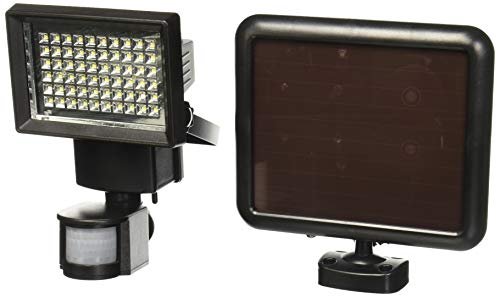
The Sunforce 82156 is the closest thing here to a traditional hardwired flood light, and it earns the top spot in our best solar motion light comparison for one design decision: its solar panel is separate from the light, connected by 15 feet of wire. That means you can mount the head on a shaded garage wall or under a roof overhang, where a flood light actually needs to point, while the amorphous panel sits on the roof in direct sun. Amorphous panels also charge in diffuse light, so output holds up better on overcast days.
Performance is solid for the class: 850 lumens from 60 LEDs, with a PIR sensor rated to detect motion at up to 30 feet across a 180 degree arc. It also offers three adjustable dials (LUX, TIME, and SENS) to tune how dark it must be, how long it stays on (30, 60, or 120 seconds), and how sensitive the trigger is. Power comes from a single rechargeable 3.7V lithium-ion battery, and the unit is fully weather resistant.
The honest downsides: Sunforce publishes no IP rating for this unit, and it is the oldest design on this list. Long term buyer reviews repeatedly describe water intrusion failures at the panel frame and lamp gasket after a season or two of harsh weather, so check the seals annually and mount the head where driving rain will not beat on it. The 3.9 star average across thousands of ratings reflects that durability spread.
Key specs: 850 lm, 60 LEDs, detection up to 30 ft at 180 degrees, separate 15 ft amorphous panel, 3.7V lithium-ion battery, adjustable LUX/TIME/SENS, weather resistant (no IP rating stated).
2. AmeriTop 128 LED Solar Motion Light: Widest Coverage
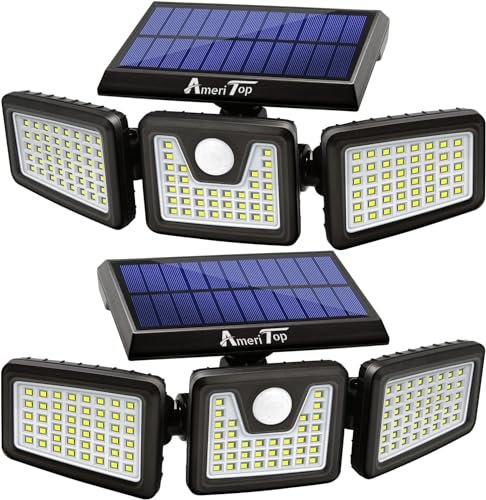
The AmeriTop 128 LED is the brightest wide-angle option here after the Sunforce, and it covers far more area per unit. Three adjustable heads aim up, down, and sideways to spread 800 lumens across a claimed 270 degree lighting angle, which makes it the right choice above a garage door or on a two car driveway where a single flat panel cannot reach the edges. The polycrystalline panel is integrated into the top of the housing, and the maker rates the cell conversion at about 20 percent. The PIR sensor detects motion at 16 to 26 feet within a 120 degree cone, then shuts off 30 seconds after movement stops. Each of the two units carries a 3.7V 2200mAh 18650 lithium-ion battery, and the housing is IP65 rated.
The honest downsides: the panel and light share one housing, so the whole unit must face the sun, which limits how you can angle the heads and rules out shaded mounting spots. There is no dim or all-night mode; it is motion triggered only, and it needs a full sunny day to recover after a few activations. It is also a two pack.
Key specs: 800 lm, 128 LEDs, three adjustable heads, 270 degree lighting angle, detection 16 to 26 ft at 120 degrees, 18650 2200mAh battery per unit, IP65.
3. Aootek AK06 120 LED Solar Lights: Best Multi-Pack Value
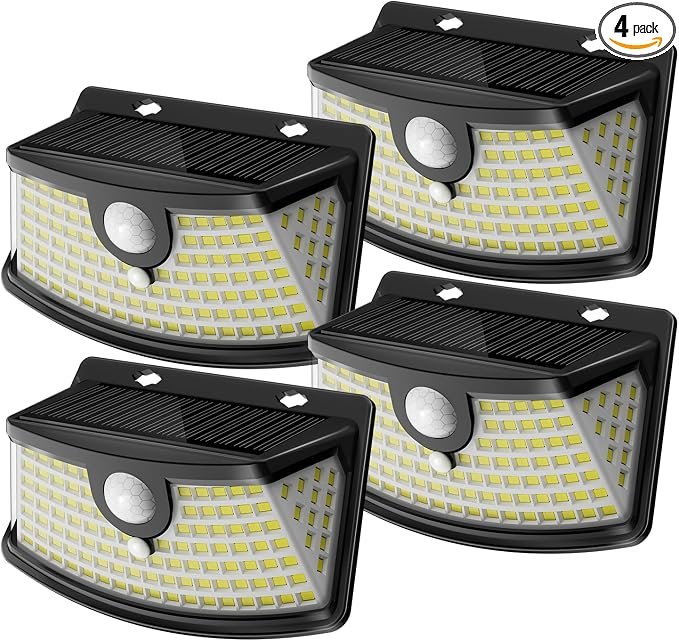
The Aootek AK06 is one of the most popular solar lights in the category, with more than 57,000 ratings averaging 4.4 stars, and its appeal is easy to explain: you get four self contained 120 LED units, each with a 1.2W monocrystalline panel rated at a 20.5 percent conversion rate, for roughly the price of one wired flood light. Each unit has a reflector to widen the beam, a PIR sensor rated to 26 feet within 120 degrees, and an IP65 housing. What sets it apart is the mode selection. Beyond the standard motion mode (dark until triggered, high brightness for about 15 seconds), it offers a permanent on mode at 10 percent brightness for up to 8 hours, and a smart mode that idles dim all night and jumps to full brightness when the sensor trips. No other pick here can hold faint all-night lighting on stored solar power.
The honest downsides: Aootek does not publish a lumen figure, and real world output is porch light brightness rather than flood light punch; buy it for coverage, not raw intensity. The batteries are sealed inside, and several cloudy days in a row will leave them dim or dark. Placement matters more here than with any other pick, because a small panel in partial shade will never fully charge. Our solar panel placement guide covers the sun angles and orientation rules that apply to these integrated panels too.
Key specs: 120 LEDs per unit (4 pack), 1.2W monocrystalline panel, three modes including all-night dim, detection up to 26 ft at 120 degrees, lithium-ion battery (capacity not stated), IP65.
4. Urpower 44 LED Solar Motion Lights: Best for Small Entry Points
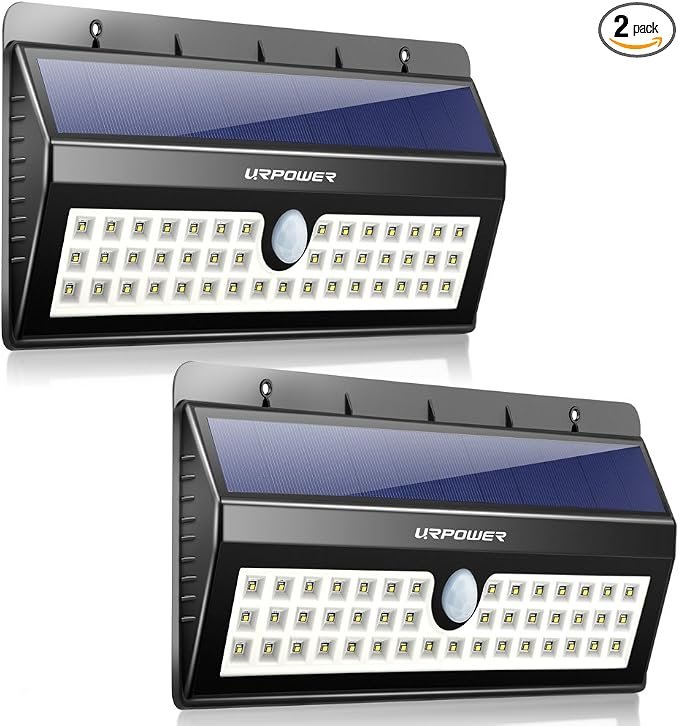
The Urpower SL-08 (44 LED, two pack) is the unit to buy for front doors, deck steps, and the dark strip beside a garage, where 500 lumens across a modest throw is plenty. It runs a 3.7V 2200mAh lithium-ion battery, charges in 6 to 8 hours of sun, and the maker rates it for at least 12 hours of medium mode lighting per full charge.
It offers three modes: continuous medium light, dim light that surges to full when motion is detected, and pure motion sensing (dark until triggered). The PIR sensor covers 9 to 16 feet within a 120 degree arc, which is the shortest detection range among these picks, so mount it where people will pass within about ten feet.
The honest downsides: the housing is rated IP64 rather than IP65, meaning it shrugs off rain but is a notch less sealed against driven water, so favor a protected wall or soffit over an exposed fence post. Output and spread are modest, and two units cover less ground than the four packs above at a similar price.
Key specs: 500 lm, 44 LEDs, detection 9 to 16 ft at 120 degrees, 3.7V 2200mAh battery, three modes, IP64, two pack.
5. Baxia Technology 100 LED Solar Lights: Best Budget Multi-Pack
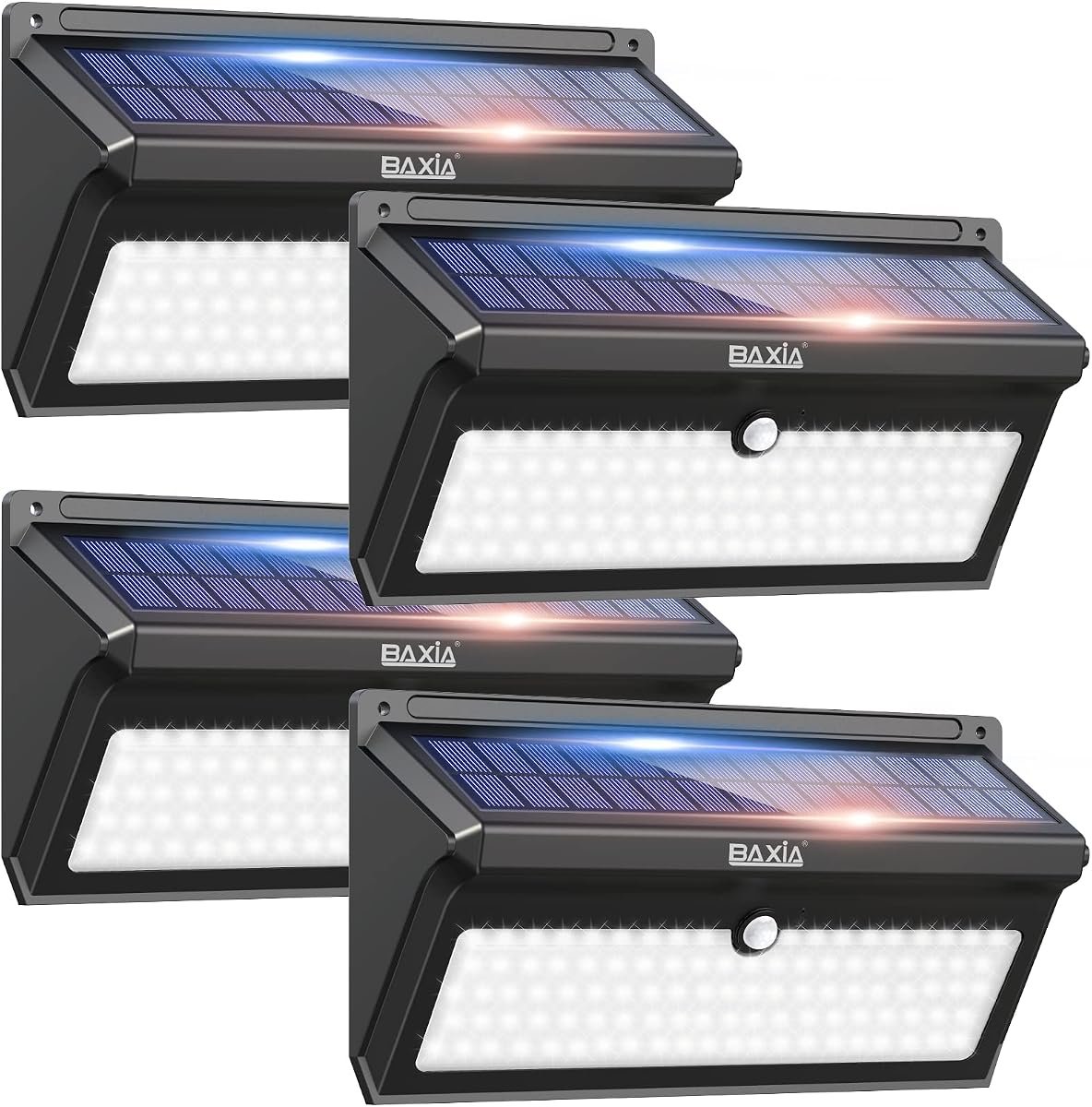
The Baxia 100 LED is the budget anchor of this list: four self contained units with a claimed 2,000 lumen output, backed by more than 13,500 ratings averaging 4.3 stars. Each light carries an IP65 rating despite its size and a PIR sensor that triggers at 10 to 16 feet across 120 degrees, and the maker says a full charge takes 6 to 8 hours of sun. It is deliberately simple: no mode button and no dim state. The light is fully dark until the sensor trips, then shuts off, a no-dim design the maker says extends battery and LED life.
That simplicity is exactly why it works as a deterrent on fence lines, side gates, and shed walls: install four around a property and any movement after dark triggers a light somewhere. Installation is two screws per unit.
The honest downsides: the maker publishes no battery capacity or panel wattage figures, and the 2,000 lumen claim should be read as a marketing peak rather than a measured figure, since lights in this class rarely hit their stated numbers in real use. The all-or-nothing operation means no ambient path lighting, the small integrated panel needs a genuinely sunny spot to recharge, and long term durability is the trade-off behind this price; expect to replace individual units after a few seasons rather than the whole set. As an entry point into solar security lighting, though, nothing else comes close.
Key specs: 100 LEDs per unit (4 pack), claimed 2,000 lm, detection 10 to 16 ft at 120 degrees, 6 to 8 hour sun charge, battery capacity not stated, no dim mode, IP65.
How to Choose a Solar Motion Security Light
Brightness and coverage. For a doorway or steps, 400 to 500 lumens is adequate. For a driveway or yard where you want to actually see what moved, 800 lumens or more is the realistic threshold, and even that is dimmer than a wired 1,500 lumen flood light. Beam geometry matters as much as lumens: adjustable heads and reflectors spread light wider than a single flat panel of the same output.
Detection range and placement. PIR sensors on these units trigger between 9 and 30 feet. Most makers suggest mounting 6 to 8 feet up, high enough to see across a yard but low enough that the sensor cone crosses a person. Aim sensors across the direction of travel; PIR reads lateral movement far better than someone walking straight at the unit.
Separate panel versus integrated panel. This is the key design split. A separate panel (Sunforce) lets you mount the light in shade and the panel in sun, and re-aim the panel seasonally. An integrated panel (everything else here) forces the whole unit into full sun, which usually means trading ideal light placement for ideal charging. Compromised charging is the number one cause of dead solar lights, not failed batteries.
Battery capacity and winter behavior. Bigger mAh means more activations per charge, but every lithium-ion battery here loses capacity in freezing weather, and none of these lights is designed to be brought indoors nightly. Treat stated runtimes as ideal-case summer figures; a string of overcast days will leave any of these dark until the sun returns, and that is physics, not defect.
Weatherproofing. Prefer IP65 over IP64 for exposed fence lines and rooflines. The Sunforce carries no IP rating at all, which is why it needs the most careful placement. Wherever you mount them, a quick seasonal cleaning of the panels keeps output up, for the same reasons outlined in our solar panel maintenance tips.
Where wired still wins. A solar motion light is the right tool when wiring is impossible, expensive, or temporary: sheds, detached garages, fence lines, gates, cabins, and RV or campsite setups, where a light that pairs naturally with a complete RV solar system is a genuine security layer. If you have easy access to mains power at the mounting point, a hardwired LED flood light will always be brighter and never care about clouds. Choose solar where wiring cannot reach, and the operating cost of your lighting drops to zero.
FAQ
How bright should a solar motion security light be?
For an entryway, 400 to 500 lumens is fine. For a driveway or backyard where identification matters, aim for 800 lumens or more, and accept that even the best solar units here are dimmer than wired flood lights.
Do solar motion lights work in winter and on cloudy days?
They work, but with less reserve. Short days and overcast skies reduce charging, so lights may dim early or skip nights after several cloudy days. Cold also cuts lithium-ion battery capacity. The Sunforce’s amorphous panel charges somewhat better in diffuse light.
How long do solar motion security lights last?
Realistically 2 to 5 years for the integrated-panel budget units, with batteries usually failing first. The multi-pack formats exist partly because replacing one dead unit is cheap. Units with replaceable batteries and separate panels (like the Sunforce) can run longer with occasional battery swaps.
Where should I mount a solar motion light?
6 to 8 feet up, facing the area you want covered, with the panel pointed toward maximum sun (south facing in the northern hemisphere). Never mount an integrated-panel light under an eave or in shade; it will run a few nights, then die until you move it.
Do solar motion lights deter burglars?
Motion triggered lighting removes the darkness an intruder wants and draws attention to movement, without the light pollution of dusk-to-dawn lighting. It is one layer of home security, not a substitute for locks, cameras, or an alarm.
Related Reading
- Advantages and Disadvantages of Solar Energy
- Maximizing Efficiency: Solar Panel Placement
- Maintenance Tips for Solar Panels
- Complete RV Solar System with Batteries
- 10 Easy Ways to Reduce Your Energy Bill at Home
Tags: solar, led lighting, outdoor gear, home efficiency, diy solar, solar security lights, motion sensor lights